
Archive

February 2026

Browsing

LOS ANGELES — The world’s biggest social media companies face several landmark trials this year that seek to hold them responsible for harms to children who use their platforms. Opening statements for the first, in Los Angeles County Superior Court, begin this week.

Instagram’s parent company Meta and Google’s YouTube will face claims that their platforms deliberately addict and harm children. TikTok and Snap, which were originally named in the lawsuit, settled for undisclosed sums.

“This was only the first case — there are hundreds of parents and school districts in the social media addiction trials that start today, and sadly, new families every day who are speaking out and bringing Big Tech to court for its deliberately harmful products,” said Sacha Haworth, executive director of the nonprofit Tech Oversight Project.

At the core of the case is a 19-year-old identified only by the initials “KGM,” whose case could determine how thousands of other, similar lawsuits against social media companies will play out. She and two other plaintiffs have been selected for bellwether trials — essentially test cases for both sides to see how their arguments play out before a jury and what damages, if any, may be awarded, said Clay Calvert, a nonresident senior fellow of technology policy studies at the American Enterprise Institute.

It’s the first time the companies will argue their case before a jury, and the outcome could have profound effects on their businesses and how they will handle children using their platforms.

KGM claims that her use of social media from an early age addicted her to the technology and exacerbated depression and suicidal thoughts. Importantly, the lawsuit claims that this was done through deliberate design choices made by companies that sought to make their platforms more addictive to children to boost profits. This argument, if successful, could sidestep the companies’ First Amendment shield and Section 230, which protects tech companies from liability for material posted on their platforms.

“Borrowing heavily from the behavioral and neurobiological techniques used by slot machines and exploited by the cigarette industry, Defendants deliberately embedded in their products an array of design features aimed at maximizing youth engagement to drive advertising revenue,” the lawsuit says.

Executives, including Meta CEO Mark Zuckerberg, are expected to testify at the trial, which will last six to eight weeks. Experts have drawn similarities to the Big Tobacco trials that led to a 1998 settlement requiring cigarette companies to pay billions in health care costs and restrict marketing targeting minors.

“Plaintiffs are not merely the collateral damage of Defendants’ products,” the lawsuit says. “They are the direct victims of the intentional product design choices made by each Defendant. They are the intended targets of the harmful features that pushed them into self-destructive feedback loops.”

The tech companies dispute the claims that their products deliberately harm children, citing a bevy of safeguards they have added over the years and arguing that they are not liable for content posted on their sites by third parties.

“Recently, a number of lawsuits have attempted to place the blame for teen mental health struggles squarely on social media companies,” Meta said in a recent blog post. “But this oversimplifies a serious issue. Clinicians and researchers find that mental health is a deeply complex and multifaceted issue, and trends regarding teens’ well-being aren’t clear-cut or universal. Narrowing the challenges faced by teens to a single factor ignores the scientific research and the many stressors impacting young people today, like academic pressure, school safety, socio-economic challenges and substance abuse.”

A Meta spokesperson said in a recent statement that the company strongly disagrees with the allegations outlined in the lawsuit and that it’s “confident the evidence will show our longstanding commitment to supporting young people.”

José Castañeda, a Google Spokesperson, said that the allegations against YouTube are “simply not true.” In a statement, he said, “Providing young people with a safer, healthier experience has always been core to our work.”

The case will be the first in a slew of cases beginning this year that seek to hold social media companies responsible for harming children’s mental well-being.

In New Mexico, opening statements begin Monday for trial on allegations that Meta and its social media platforms have failed to protect young users from sexual exploitation, following an undercover online investigation. Attorney General Raúl Torrez in late 2023 sued Meta and Zuckerberg, who was later dropped from the suit.

Prosecutors have said that New Mexico is not seeking to hold Meta accountable for its content but rather its role in pushing out that content through complex algorithms that proliferate material that can be harmful, saying they uncovered internal documents in which Meta employees estimate that about 100,000 children every day are subjected to sexual harassment on the company’s platforms.

Meta denies the civil charges while accusing Torrez of cherry-picking select documents and making “sensationalist” arguments. The company says it has consulted with parents and law enforcement to introduce built-in protections to social media accounts, along with settings and tools for parents.

A federal bellwether trial beginning in June in Oakland, California, will be the first to represent school districts that have sued social media platforms over harms to children.

In addition, more than 40 state attorneys general have filed lawsuits against Meta, claiming it is harming young people and contributing to the youth mental health crisis by deliberately designing features on Instagram and Facebook that addict children to its platforms. The majority of cases filed their lawsuits in federal court, but some sued in their respective states.

TikTok also faces similar lawsuits in more than a dozen states.

This post appeared first on NBC NEWS

Relationship Represents Potential Long Term Scalability of High Efficiency Supply Chain from Demonstration to Commercial Scale

Syntholene Energy CORP (TSXV: ESAF) (FSE: 3DD0) (OTCQB: SYNTF) (‘Syntholene’ or the ‘Company’) announces that it has selected Dynelectro ApS (Denmark) as the electrolyzer technology vendor for its planned synthetic fuel demonstration facility in Iceland. Dynelectro is the developer of what it describes as the world’s most efficient electrolyzer platform, purpose-built for high-performance hydrogen production in power-to-liquids applications for synthetic fuel (‘eFuel’) and, more specifically, synthetic sustainable aviation fuel (‘eSAF’).

Dynelectro’s electrolyzer platform has demonstrated industry-leading energy efficiency in the production of hydrogen, a key feedstock to eFuels, while maintaining durability under continuous industrial operation at variable load. The system architecture emphasizes reduced balance-of-plant complexity, high current density operation, and modular deployment, characteristics that align closely with Syntholene’s objective of developing capital-efficient, repeatable synthetic fuel infrastructure.

The planned demonstration facility is intended to validate the Company’s integrated approach to producing low-cost hydrogen as a feedstock to eSAF and other eFuels, with a focus on scalability, energy efficiency, and long-term cost competitiveness with fossil fuels.

‘Syntholene’s eSAF production plans are a perfect match for Dynelectro’s electrolyser solution,’ explains Sune Lilbaek, CEO at Dynelectro ApS. ‘To be successful in the eSAF market, the lowest possible cost of hydrogen over the lifespan of the plant is a necessity. Dynelectro’s unique take on SOEC electrolysers seeks to enable the lowest possible energy consumption and maintenance cost. When integrated with Syntholene’s proprietary hybrid thermal production system, it is possible to convert up to 90% of the renewable electrical energy supplied into clean hydrogen. Together, we expect to be deploying the most cost-effective, energy-efficient solution for production of sustainable aviation fuel on the market today.’

The vendor selection represents a key technical milestone for Syntholene as it advances engineering and procurement activities associated with its first demonstration-scale facility.

‘The selection of Dynelectro is the result of a rigorous two-year technical and commercial evaluation process across all major vendors focused on efficiency, reliability, and long-term scalability,’ said Dan Sutton, CEO of Syntholene. ‘Electrolyzer performance coupled with low-cost clean energy are the primary drivers of synthetic fuel economics. Partnering with a technology provider that prioritizes energy efficiency and industrial robustness is critical as we move from demonstration toward multi-megawatt commercial deployment.’

About Syntholene

Syntholene is actively commercializing its novel Hybrid Thermal Production System for low-cost clean fuel synthesis. The target output is ultrapure synthetic jet fuel, manufactured at 70% lower cost than the nearest competing technology today. The company’s mission is to deliver the world’s first truly high-performance, low-cost, and carbon-neutral synthetic fuel at an industrial scale, unlocking the potential to produce clean synthetic fuel at lower cost than fossil fuels, for the first time.

Syntholene’s power-to-liquid strategy harnesses thermal energy to power proprietary integrations of hydrogen production and fuel synthesis. Syntholene has secured 20MW of dedicated energy to support the Company’s upcoming demonstration facility and commercial scale-up.

Founded by experienced operators across advanced energy infrastructure, nuclear technology, low-emissions steel refining, process engineering, and capital markets, Syntholene aims to be the first team to deliver a scalable modular production platform for cost-competitive synthetic fuel, thus accelerating the commercialization of carbon-neutral eFuels across global markets.

About Dynelectro

Dynelectro is a Danish SOE electrolyser OEM at the forefront of developing advanced, sustainable energy solutions. Utilising cutting-edge solid-oxide electrolysis technology, Dynelectro achieves unprecedented system performance and lifespan, enabling a five-fold improvement in lifetime performance through a novel approach to stack control and integration. Their innovations enable operators to seamlessly adjust production based on the availability of cost-effective renewable energy.

The company commercialises MW-scale Dynamic Electrolyser Units (DEUs), producing clean hydrogen to unlock syngas and e-fuel production. Dynelectro was founded in 2018 and is headquartered in the capital region of Denmark. Visit www.dynelectro.dk

For further information, please contact:
Dan Sutton, CEO
comms@syntholene.com
www.syntholene.com

Investor Relations
KIN Communications Inc.
604-684-6730
ESAF@kincommunications.com

Forward-Looking Statements
This press release contains forward-looking statements within the meaning of applicable securities laws. The use of any of the words ‘expect’, ‘anticipate’, ‘aims’, ‘continue’, ‘estimate’, ‘objective’, ‘may’, ‘will’, ‘project’, ‘should’, ‘believe’, ‘plans’, ‘intends’ and similar expressions are intended to identify forward-looking information or statements. All statements, other than statements of historical fact, including but not limited to statements regarding the use of a particular vendor, the services to be provided and standard of delivery, expected benefits of engagement of certain service providers, development of the Company’s test facility, commercial scalability, technical and economic viability, anticipated geothermal power availability, anticipated benefit of eFuel, the Company’s business plans, and future commercial opportunities, are forward-looking statements.

The forward-looking statements and information are based on certain key expectations and assumptions made by the Company, including without limitation the assumption that the Company will be able to execute its business plan, that the eFuel will have its expected benefits, that the selected vendor will be able to complete their deliverables on time and to the standard expected, that the test facility will be completed as planned, that there will be market adoption, and that the Company will be able to access financing as needed to fund its business plan. Although the Company believes that the expectations and assumptions on which such forward-looking statements and information are based are reasonable, undue reliance should not be placed on the forward-looking statements and information because the Company can give no assurance that they will prove to be correct. Since forward-looking statements and information address future events and conditions, by their very nature, they involve inherent risks and uncertainties.

Actual results could differ materially from those currently anticipated due to a number of factors and risks, including, without limitation, Syntholene’s ability to meet production targets, realize projected economic benefits, meet targeted timelines for development, overcome technical challenges, secure financing, maintain regulatory compliance, manage geopolitical risks, and successfully negotiate definitive terms. Syntholene does not undertake any obligation to update or revise these forward-looking statements, except as required by applicable securities laws.

Readers are advised to exercise caution and not to place undue reliance on these forward-looking statements.

To view the source version of this press release, please visit https://www.newsfilecorp.com/release/283350

News Provided by TMX Newsfile via QuoteMedia

This post appeared first on investingnews.com

President Donald Trump vowed to impose ‘very severe consequences’ on Russia in 2025 if it didn’t commit to a deal to end its war on Ukraine.

As the war nears its four-year anniversary in late February, national security experts tell Fox News Digital that Russia is facing tangible consequences for the war. Those are through its network of proxy countries that have directly endured the might of the U.S. military and subsequently left Russia with fewer streams of revenue and resources, they say. 

‘The President’s moves as it pertains to Russia are really strategic,’ Morgan Murphy, who previously served as the senior public diplomacy advisor to the president’s special envoy to Ukraine in 2025, told Fox News Digital. ‘So if you look at what he’s done with Iran and with Venezuela, these are two Russian proxies, right? Iran is a close ally of Russia.’

‘They sell a lot of drones to Russia,’ Murphy, who is running as a GOP Senate candidate to represent Alabama, continued. ‘Venezuela was again a proxy of Russia here in our hemisphere, and Trump is in the process of taking Iran off the table. He’s certainly taken Venezuela off the chessboard, and that that has to change Putin’s calculus, because he sees in President Trump a president who follows what he says he’s going to do.’ 

Russia’s war on Ukraine has persisted since Feb. 24, 2022, about a year after Trump’s first administration ended and during President Joe Biden’s presidency. Trump campaigned on ending the war upon his second inauguration in 2025, but ending the war has proven more difficult than anticipated as the U.S. continues negotiations. 

A White House official who spoke to Fox Digital said Trump is driven by humanitarian concerns and wants the conflict ended to stop the needless loss of life. The official added that in recent months his team has made major headway toward a settlement, pointing to Trump’s own remarks that ‘very good things’ are developing between Ukraine and Russia.

According to the official, recent negotiations in Abu Dhabi, United Arab Emirates, were substantive and constructive, with U.S., Ukrainian and Russian delegations agreeing to a 314-person prisoner exchange — the first in five months. While more work is ahead, the official argued that breakthroughs like this show sustained diplomacy is producing real, measurable progress toward ending the war.

Trump launched a series of strikes on Iran in June 2025 that hobbled the country’s covert nuclear program. Massive protests swept Iran in December 2025 as citizens spoke out against the government and its cratering economy. 

Iran violently cracked down on the nationwide protests, with thousands of citizens reportedly killed and the Trump administration warning Iran that it would face U.S. military action if the executions and killings continued. 

The U.S. and Iran held discussions in Oman Friday as Tehran, Iran, continues to obscure its nuclear ambitions, with military intervention on the table as the U.S. seeks to prevent Iran from having nuclear weapons capabilities. 

Iran and Russia have grown into a tighter wartime partnership in recent years, with U.S. and allied officials citing Iran’s supply of armed drones and other defense cooperation that has helped power Russia’s attacks in Ukraine — drawing the two heavily sanctioned regimes closer economically and militarily.

Ret. Air Force Gen. Bruce Carlson pointed to the Trump administration’s actions on Iran and Venezuela as evidence of how Trump is strategically pressuring Russia via its proxies to end the war in Ukraine. 

‘In any campaign, you don’t just target command centers — you cut supply lines and logistics,’ Carlson said. ‘Pressuring Russian proxies does exactly that. Venezuela, Iran, and the shadow fleet are key arteries feeding Russia’s war in Ukraine. Additionally, by pressing Europe to increase NATO spending and move off Russian oil and gas, we are directly altering Moscow’s decision-making.’

Carlson argued that, strategically, the trend lines are moving against Moscow as the U.S. ramps up pressure on Russia’s partners — leaving Putin with fewer backers, tighter resources and less flexibility, and undermining any assumption that dragging out the war comes without a cost. 

The retired Air Force general added that Putin and his proxies operate as a single ecosystem: Russia’s campaign relies on outside suppliers and sanctions-busting networks, so hitting any link in that chain can weaken Russia’s revenue and its ability to sustain attacks on Ukrainian civilians.

‘But ensuring a lasting and fair peace is not solely about pressuring Russia. As the cold winter continues in Ukraine, there are increasing concerns on Ukraine’s energy needs and air defense systems. U.S. and European support remain vital,’ he added. 

As tensions with Iran heighten, the Trump administration successfully captured Venezuelan dictator Nicolás Maduro on sweeping narco-trafficking charges in January. 

Venezuela is another Russian ally, publicly backing Moscow and maintaining high-level diplomatic ties, while giving Russia a Western Hemisphere foothold through military-technical cooperation and deep dependence on Russian arms — a relationship that has triggered U.S. sanctions actions tied to Venezuela’s oil sector and Russian-linked firms.

‘The removal of Maduro stripped Moscow of a key client in our hemisphere, and the increased pressure on Iran threatens the weapons and drone supply chain that Russia uses against Ukrainian civilians,’ Carrie Filipetti, executive director of foreign policy group the Vandenberg Coalition, told Fox News Digital. ‘This is how we have to change Putin’s long-term calculus.’

‘For the first time, the United States has used the power of American diplomacy to bring Ukraine and Russia into trilateral diplomatic talks,’ Filipetti added. ‘Combined with the threat of additional sanctions reliance and increased pressure on the countries that buy Russian energy, these steps are critical to shaking Russia’s assumption that time is on its side.’ 

Ret. Air Force Lt. Gen. Richard Newton told Fox News Digital that when Trump warned Russia of severe consequences in 2025 if Moscow did not end the war, the threat was followed by tangible consequences that reverberated through the Kremlin. 

‘Deterrence and leverage requires our adversaries (to) believe we will act,’ Newton said. ‘President Trump is doing just that by disrupting the systems that fund and sustain Putin’s war. The capture of Maduro and the just announced trade deal with India’s Prime Minister Modi — that forces India off of Russian oil — is a major blow to Russia’s war machine.’

The White House said in February that it struck with India to increase U.S. energy imports and stop buying Russian oil. The U.S. tops the world in daily oil production, with Saudi Arabia and Russia following behind. 

Filipetti argued that peace in Ukraine is only obtained by forcing Russia to face ‘real consequences.’

‘Vladimir Putin is responsible for a war of aggression marked by atrocities against Ukrainian civilians, and any lasting peace must impose real consequences on Russia itself. And weakening Russia’s proxies and isolating Putin is one of the most effective ways to reduce his ability to wage war,’ Filipetti said.

‘When it comes to China, North Korea, and Iran — without question these authoritarians are facing a very different calculus than just a few months ago,’ she said. 

While Newton pointed to a shadow-fleet sanctions package and another sanctions package that are moving through Congress, along with higher NATO spending and a tougher allied military posture, as key pressure points he says could help drive a peace deal.

Republican South Carolina Sen. Lindsey Graham is promoting a sweeping Russia sanctions bill that would tighten the screws on Moscow by punishing countries and companies that keep buying Russian energy with secondary sanctions and tariffs, while a separate bipartisan ‘shadow fleet’ package would target the tankers, insurers and shell networks Russia uses to move oil and evade sanctions.

Murphy argued that Trump already has sketched what he sees as a realistic off-ramp for Moscow — one he says even some Democrats would recognize as the best deal Putin is likely to get — including restoring Russia’s seat at the top diplomatic table, reopening some Western commercial access, and acknowledging Russia’s current occupation of Ukrainian territory without formally recognizing sovereignty. 

Murphy likened that offer to a ‘golden bridge’ for Putin to exit the war, but said the Kremlin has so far declined it, making the next move ultimately Russia’s choice — and raising the question of how many more casualties Moscow is willing to absorb with no clear endpoint in sight.

The war underscores a Russian worldview U.S. negotiators often misread through a Western lens, Murphy said, explaining Russia is shaped by catastrophic losses in World War I and World War II and a deep-seated suspicion that invasion is a recurring threat. He said that unpredictability is why the U.S. military has long used the ‘Crazy Ivan’ moniker for Russian behavior. 

Trump is meanwhile putting himself in the Russians’ shoes, Murphy argued, and meeting the moment with a clearer-eyed read of Moscow’s mindset and history. 

‘It is a decision that the Russians are going to have to make. How many more lives do they want to feed into this meat grinder? How many more deaths are they willing to endure?’ Murphy said. 

Ukrainian President Volodymyr Zelenskyy told reporters in February that the U.S. set a June deadline for Moscow and Kyiv to strike an agreement to end the war, teeing up heightened tensions ahead of the U.S. midterms in November. 

This post appeared first on FOX NEWS

Here’s a quick recap of the crypto landscape for Monday (February 9) as of 9:00 a.m. UTC.

Get the latest insights on Bitcoin, Ether and altcoins, along with a round-up of key cryptocurrency market news.

Bitcoin (BTC) was priced at US$69,837.08, down by 1.1 percent over 24 hours.

Bitcoin price performance, February 9, 2026.

Chart via TradingView

Ether (ETH) was priced at US$2,049.31, down by 3.5 percent over the last 24 hours.

Altcoin price update

  • XRP (XRP) was priced at US$1.41, down by 3.5 over 24 hours.
  • Solana (SOL) was trading at US$84.50, down by 3.9 percent over 24 hours.

Today’s crypto news to know

Tether deepens gold push with US$150M stake in Gold.com

Tether has made a US$150 million investment in Gold.com, acquiring roughly a 12 pecent minority stake as it moves to broaden access to both tokenized and physical gold.

The deal sets up a long-term partnership that will integrate Tether’s gold-backed token, XAU₮, into Gold.com’s platform and explore ways for customers to buy physical gold using digital currencies such as USDT and the newly launched, federally regulated USA₮.

The move comes as gold prices push above US$5,000 an ounce, reinforcing demand for hard-asset exposure amid geopolitical and macroeconomic uncertainty. Tether said the gold-backed stablecoin market has nearly tripled over the past year to more than US$5.5 billion, with XAU₮ accounting for over 60 percent of total market value.

The company says XAU₮ is backed 1:1 by allocated physical gold, with about 140 tons in total held in secure vaults and each token linked to a specific London Good Delivery bar.

Bitcoin breaks below US$70,000 as liquidations accelerate

Bitcoin fell sharply this week, breaking below the closely watched US$70,000 level and trading as low as roughly US$60,300 before stabilizing near US$65,000

The US$70,000 mark had become a crowded positioning zone, and once it failed, mechanically driven selling took over.

In addition, the Crypto Fear & Greed Index dropped to 9, its lowest reading in nearly four years, while futures open interest slid toward multi-month lows, signaling defensive positioning rather than dip-buying. “

South Korea tightens scrutiny after Bithumb’s distribution error

South Korea’s Financial Supervisory Service has moved to strengthen oversight of crypto exchanges following a major error at Bithumb that briefly flooded user accounts with billions of dollars’ worth of bitcoin.

The incident occurred when customers were mistakenly credited with roughly 2,000 BTC each instead of small promotional rewards, triggering panic selling and a sharp price dislocation on the exchange.

Bitcoin prices on Bithumb fell as much as 30 percent below global levels before trading and withdrawals were halted.

Authorities said the episode exposed “vulnerabilities and risks” in virtual asset systems and raised concerns about internal controls and reserve backing. “It is a case that shows the structural problems of electronic systems for virtual assets,” said Lee Chan-jin, governor of South Korea’s Financial Supervisory Service.

Regulators plan to introduce tougher penalties for IT failures and expand monitoring tools that flag suspicious trading patterns in real time.

Of the more than 620,000 bitcoins mistakenly distributed, authorities said nearly all have since been recovered.

FDIC settles FOIA fight over crypto ‘pause letters’

The Federal Deposit Insurance Corporation (FDIC) has agreed to pay US$188,440 in legal fees and drop its effort to withhold crypto-related “pause letters,” settling a Freedom of Information Act lawsuit tied to alleged debanking practices.

The case stemmed from a records request filed by History Associates on behalf of Coinbase, seeking documents that showed how banks were allegedly pressured to halt or limit crypto activities.

A federal court ruled last year that the FDIC violated FOIA by categorically withholding the letters rather than reviewing them individually.

“We successfully uncovered dozens of crypto ‘pause letters’—indisputable proof of OCP2.0,” Coinbase chief legal officer Paul Grewal wrote on X after the settlement.

Securities Disclosure: I, Meagen Seatter, hold no direct investment interest in any company mentioned in this article.

Securities Disclosure: I, Giann Liguid, hold no direct investment interest in any company mentioned in this article.

This post appeared first on investingnews.com

Neither party has put a stake in the ground on the issue that will drive the next presidential election cycle. Artificial intelligence is expected to transform the global economy at a dizzying pace, radically reordering nearly every industry and bringing with it unprecedented disruptions in the labor market.

Nobody is prepared to address what could be the biggest issue of 2028. In a recent earnings call, xAI founder Elon Musk described an exciting era of abundance in which AI and robotics take over labor and Americans enjoy what he calls ‘universal high income.’ But that vision raises more questions than it answers.

Where do people go when entire industries shrink? How do we fulfill our need for meaningful work? Who decides how to distribute this ‘universal high income?’ What is the role of higher education? How much government would we need?

As America approaches its 250th anniversary this summer, we celebrate principles of individual liberty, free markets and limited government that have propelled our prosperity for more than two centuries. Are those principles compatible with Musk’s vision of a post-labor economy featuring universal income distribution? 

We have to come to terms with where this AI revolution could take us. In the world of politics, which tends to follow where the winds are blowing, what are the principles that remain timeless? Who do we trust to steer us in these uncertain waters?

Economic incentives are about to shift dramatically. Will free-market Republicans be tempted to become protectionists? Will big government progressives have to embrace deregulation and nuclear energy to protect threatened industries?

I expect every other issue to take a backseat to the looming questions that affect young and old, rich and poor. Traditional political alignments may be turned on their heads. This is too important for us to get it wrong. We can’t just respond reflexively. 

AI may offer Americans a generational opportunity to double down on the foundational principles that historically drove our prosperity. But we can expect strong headwinds pushing us toward revisiting the collectivist experiments that have consistently failed in the past.

The rules are changing. You used to be able to protect your likeness, your works. We had patents, trademarks, boundaries. But now with deepfakes, generative AI and apps that will undress anyone at the touch of a button, we need to come together to establish a better framework of boundaries.

Both parties need to come up with a vision to steer AI toward empowerment, foster independence and amplify human potential rather than erode it. Historical precedents suggest technological advances, though disruptive, ultimately create more opportunities than they destroy.

I’m hopeful that AI will create new roles we cannot yet fully imagine, perhaps allowing workers to focus on strategic and creative roles that machines can’t replicate. AI doesn’t have to be the end of work. It can be the beginning of better work.

Economic incentives are about to shift dramatically. Will free-market Republicans be tempted to become protectionists? Will big government progressives have to embrace deregulation and nuclear energy to protect threatened industries?

But in the process of getting from here to there, we face challenges that will test our resolve and the foundational principles that sustain our past success. AI threatens to create the perfect opportunity for globalists to build the central-planned economy they’ve always wanted.

America is very good at harnessing innovation to foster independence. If we approach this the right way, AI may empower us to innovate — to build a future where every American contributes on their own terms. We know that government doesn’t create jobs. Entrepreneurs do.

The key is not to resist, but to embrace AI as a tool that enhances independence — freeing us for meaningful pursuits like family, community and invention. We can build a future where every American contributes on their terms. For 250 years, these principles have stood the test of time. Instead of resisting progress we need to be directing it to more productive use.

This post appeared first on FOX NEWS

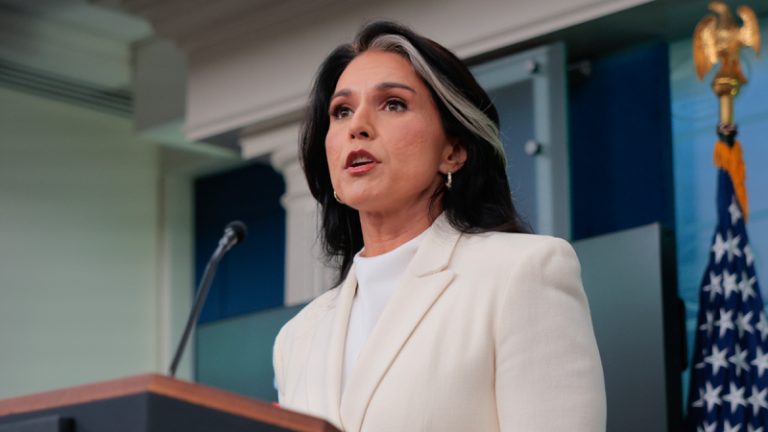
Director of National Intelligence Tulsi Gabbard denied any wrongdoing on Saturday as Democrats question why a whistleblower complaint filed against her last May took nearly a year before it was referred to Congress.

‘[Virginia Democrat] Senator Mark Warner and his friends in the Propaganda Media have repeatedly lied to the American people that I or the ODNI ‘hid’ a whistleblower complaint in a safe for eight months,’ Gabbard wrote in a lengthy X post on Saturday. ‘This is a blatant lie.’

She continued, ‘I am not now, nor have I ever been, in possession or control of the Whistleblower’s complaint, so I obviously could not have ‘hidden’ it in a safe. Biden-era IC Inspector General Tamara Johnson was in possession of and responsible for securing the complaint for months.’

The highly classified complaint by a U.S. intelligence official alleging wrongdoing on the part of Gabbard was filed eight months ago with the intelligence community’s watchdog office and was first reported on by the Wall Street Journal.

The complaint has been locked in a safe since its filing, according to the Journal, with one U.S. official telling the newspaper that the disclosure of its contents could cause ‘grave damage to national security.’

The whistleblower’s lawyer has accused Gabbard’s office of slow-walking the complaint, which her office has denied, calling it ‘baseless and politically motivated.’ 

Meanwhile, Democrats are also questioning why it took her office so long to hand the complaint over to Congress.

‘The law is clear,’ Warner, the senior Democrat on the Senate Intelligence Committee, said Thursday, according to NPR, adding that the complaint was required to be sent to Congress within 21 days of its filing. ‘I think it was an effort to try to bury this whistleblower complaint.’

Neither the contents of the complaint nor the allegations against Gabbard have been revealed.

Gabbard wrote on Saturday that the first time she saw the complaint was ‘when I had to review it to provide guidance on how it should be securely shared with Congress.’

‘As Vice Chair of the Senate Intelligence Committee, Senator Warner knows very well that whistleblower complaints that contain highly classified and compartmented intelligence—even if they contain baseless allegations like this one—must be secured in a safe, which the Biden-era Inspector General Tamara Johnson did and her successor, Inspector General Chris Fox, continued to do,’ she continued. ‘After IC Inspector General Fox hand-delivered the complaint to the Gang of 8, the complaint was returned to a safe where it remains, consistent with any information of such sensitivity.’

She claimed that either ‘Warner knows these facts and is intentionally lying to the American people, or he doesn’t have a clue how these things work and is therefore not qualified to be in the U.S. Senate.’

Gabbard further wrote that ‘When a complaint is not found to be credible, there is no timeline under the law for the provision of security guidance. The ‘21 day’ requirement that Senator Warner alleges I did not comply with, only applies when a complaint is determined by the Inspector General to be both urgent AND apparently credible. That was NOT the case here.’

An inspector general representative said that it had determined some of the allegations in the complaint against Gabbard weren’t credible, while it hasn’t made a determination on others, according to the Journal.

Gabbard said she was made aware that she needed to provide security guidance on the complaint by IC Inspector General Chris Fox on Dec. 4, ‘which he detailed in his letter to Congress.’

Afterward, she said she ‘took immediate action to provide the security guidance to the Intelligence Community Inspector General, who then shared the complaint and referenced intelligence with relevant members of Congress last week.’

In closing her post, Gabbard once again accused Warner of spreading ‘lies and baseless accusations over the months for political gain,’ which she said ‘undermines our national security and is a disservice to the American people and the Intelligence Community.’

Warner’s office told Fox News Digital Gabbard’s post was an ‘inaccurate attack that’s entirely on brand for someone who has already and repeatedly proven she’s unqualified to serve as DNI.’ 

Republicans on the House and Senate intelligence committees have backed up Gabbard, with Sen. Tom Cotton, R-Ark., writing on X on Thursday: ‘I have reviewed this ‘whistleblower’ complaint and the inspector general handling of it. I agree with both inspectors general who have evaluated the matter: the complaint is not credible and the inspectors general and the DNI took the necessary steps to ensure the material has handled and transmitted appropriately in accordance with law.’

He addded, ‘To be frank, it seems like just another effort by the president’s critics in and out of government to undermine policies that they don’t like; it’s definitely not credible allegations of waste, fraud, or abuse.’

Gabbard’s office did not immediately respond to Fox News Digital’s request for comment.

This post appeared first on FOX NEWS

For years, blockchain had promise in the finance industry, but lacked the liquidity and connectivity to scale.

Yuval Rooz, CEO and co-founder of Canton Network, believes that era is now ending.

The problem: Legacy friction

Traditional banking still depends on millions of costly, slow and error-prone messages as institutions attempt to reconcile fragmented records across systems.

Repurchase agreement (repo) trades highlight the problem. Moving cash and collateral typically requires multiple intermediaries, manual checks and settlement delays that can stretch for days.

Public blockchains such as Ethereum offer speed, but their full transparency creates a different obstacle, exposing sensitive transaction data that banks cannot legally or competitively disclose.

At the heart of the issue is a structural trade off. Banks need shared networks to scale efficiency, yet legacy infrastructure and open ledgers force a choice between operating in isolation or revealing too much information. The result has been a patchwork of private systems that protect data sovereignty, but sacrifice interoperability and efficiency.

Explaining how Canton’s technology removes that trade off, Rooz said:

“Banks built walled gardens because there was no way to share infrastructure without giving up control or privacy. What we’re seeing now is a gradual shift away from isolated systems toward shared rails where institutions retain sovereignty over their data, while still achieving interoperability.

‘That doesn’t mean internal systems disappear overnight, but it does mean the center of gravity shifts toward networks where counterparties can transact in real time.”

Canton’s solution: Privacy-enabled synchronization

Canton has created a shared ledger where institutions maintain private blockchains, yet synchronize seamlessly.

“I think critics misunderstand what financial institutions actually need,” Rooz explained. “Banks don’t want a system where everything is hidden, and they don’t want one where everything is public. They need a way to work together on shared processes, while keeping sensitive details private. That’s what Canton was designed for.”

In practice, JPMorgan keeps its ledger sovereign, while plugging into LSEG for atomic delivery-versus-payment (DvP) settlements, all without revealing private data. Sub-transaction privacy ensures only trade participants see details; to others, it’s invisible. This network of networks lets banks achieve interoperability without sacrificing control.

“(This) gives institutions a shared record they can trust, with configurable privacy at the protocol level to divulge transactional information only with involved parties. And because it’s built to connect different applications, firms can link markets and workflows together without sacrificing confidentiality,’ said Rooz.

“This combination is something traditional systems cannot offer and is why you’re seeing institutions move from pilots into production onchain,’ the expert added.

Live momentum: JPM Coin and tokenized repos

JPM Coin’s native integration is a strong signal that the market is maturing.

JPMorgan’s blockchain rail, with over US$1 trillion in processed volume, has fueled settlements across Canton’s ecosystem. Paired with LSEG’s tokenized deposits, which power live repo activity, there are now synchronized markets where DvP happens in seconds, not days.

Rooz highlighted the deeper impact, commenting, “Everyone notices the speed, but the collateral mobility is the substance beyond the headline. In legacy markets, collateral spends most of its life idle because moving it safely across systems requires messaging, reconciliation and time. Atomic settlement collapses those steps into a single transaction.’

He added, ‘When repos settle in seconds, collateral stops being static and becomes reusable. That improves liquidity, balance sheet efficiency and risk management.”

2026 outlook

JPM Coin and LSEG repos demonstrate Canton’s shift from pilots to production.

“We measure success by utilization,” said Rooz, adding, “Having Canton be the network where real transactions are taking place, and regulated assets are moving.’

He envisions steady expansion powering this transformation. Indeed, similar efforts are already live elsewhere, such as BlackRock’s BUIDL fund, which has tokenized US$1.7 billion in treasuries for 24/7 yields, and DRW Cumberland’s weekend repos, which use tokenized collateral with instant DvP settlements.

“I’d like to see more asset classes brought on to Canton, and the corresponding transaction volume we’re already seeing will continue to grow in the year ahead,’ said Rooz.

He sees this convergence accelerating across markets.

“Our ‘North Star’ is to drive the convergence of TradFi and DeFi onchain to create a new AllFi reality,’ he said.

Securities Disclosure: I, Meagen Seatter, hold no direct investment interest in any company mentioned in this article.

This post appeared first on investingnews.com

President Donald Trump on Thursday signed an executive order requiring the government to assess foreign weapons sales based on their impact on U.S. production capacity for key systems and to favor allies whose defense investments and strategic importance align with U.S. national security priorities.

Under the order, obtained first by Fox News Digital, the Departments of War, State and Commerce are instructed to ensure that U.S. arms transfers support weapons systems deemed most operationally relevant to the National Security Strategy, reinforce critical supply chains, and prioritize partners that have invested in their own defense and occupy strategically important regions.

The administration argues that past arms transfer policy allowed foreign demand to shape U.S. production decisions, contributing to backlogs, cost overruns and delivery delays that left both the U.S. military and its allies waiting years for critical equipment.

‘The America First Arms Transfer Strategy will now leverage over $300 billion in annual defense sales to strategically reindustrialize the United States and rapidly deliver American-manufactured weapons to help our partners and allies establish deterrence and defend themselves,’ according to a White House fact sheet.

A central goal of the order is to speed up a foreign military sales process that defense officials and industry leaders have long criticized as slow and overly bureaucratic. The order directs federal agencies to identify ways to streamline enhanced end-use monitoring requirements, third-party transfer approvals and the congressional notification process — steps the administration says have contributed to years-long delays in delivering U.S. weapons overseas.

The order also creates a new Promoting American Military Sales Task Force charged with overseeing implementation of the strategy and tracking major defense sales across the government. In a move aimed at increasing accountability, the administration says agencies will be required to publish aggregate quarterly performance metrics showing how quickly defense sales cases are being executed.

 The strategy also signals a shift in how the United States prioritizes its partners. The order directs the government to favor countries that have invested in their own defense and occupy strategically important regions, effectively tying arms sales decisions more closely to U.S. military planning and geographic priorities.

Other partners could face longer timelines or lower priority if their requests do not align with U.S. strategic or industrial objectives. While the order does not name specific countries, it reflects an effort to focus limited U.S. production capacity on allies viewed as most critical to executing the National Security Strategy.

The order also instructs the War, State and Commerce departments to ‘find efficiencies in the Enhanced End Use Monitoring criteria, the Third-Party Transfer process, and the Congressional Notification process.’

Congress will likely be watching how the administration implements the order, especially provisions aimed at speeding both oversight of U.S. weapons once they are sold abroad and the process for notifying lawmakers about major arms deals. Lawmakers have argued those steps help prevent misuse of U.S. weapons, even as they have criticized delays that slow deliveries to allies.

The order follows a series of recent defense-related executive actions taken by Trump. In January 2026, he signed an order directing defense contractors to prioritize production capacity, innovation and on-time delivery over stock buybacks and other corporate distributions.

That built on an April 2025 order aimed at improving speed and accountability in the foreign military sales system, as well as a January 2025 order focused on modernizing defense acquisitions and reducing red tape across the defense industrial base.

This post appeared first on FOX NEWS

Proceeds to be used to Accelerate Procurement and Component Assembly for Demonstration Facility Deployment in Iceland

Syntholene Energy CORP. (TSXV: ESAF,OTC:SYNTF) (FSE: 3DD0) (OTCQB: SYNTF) (the ‘Company’ or ‘Syntholene’) announces that it intends to complete a non-brokered private placement of up to $2.0 million (the ‘Financing’).

The Financing is expected to consist of the issuance of units of the Company (the ‘Units’) at a price of $0.45 per Unit, with each Unit comprising one common share of the Company (a ‘Common Share’) and one non-transferable common share purchase warrant (each whole warrant, a ‘Warrant’). Each whole Warrant will entitle the holder to purchase one additional Common Share at an exercise price of $0.63 for a period of two years from the date of issuance, subject to an acceleration provision in accordance with the terms of the Financing.

Gross proceeds from the Financing are expected to be used as follows: up to approximately $1.5 million toward the procurement and assembly of components for the Company’s planned demonstration facility in Iceland, and up to approximately $0.5 million toward corporate marketing initiatives, investor relations and working capital.

The Company expects that insiders of the Company may participate in the Financing. The extent of insider participation, if any, has not been determined at this time. Any insider participation will be disclosed in accordance with the policies of the TSX Venture Exchange and applicable securities laws.

Finder’s fees may be payable in connection with the Financing, subject to compliance with applicable securities laws and the policies of the TSX Venture Exchange.

All securities issued pursuant to the Financing will be subject to a statutory hold period of four months and one day from the date of issuance, in accordance with applicable securities laws. Completion of the Financing remains subject to the receipt of all required regulatory approvals, including approval of the TSX Venture Exchange.

The securities offered pursuant to the Financing have not been and will not be registered under the United States Securities Act of 1933, as amended, and may not be offered or sold in the United States absent registration or an applicable exemption from the registration requirements. This news release does not constitute an offer to sell or a solicitation of an offer to buy securities in any jurisdiction in which such offer, solicitation or sale would be unlawful.

About Syntholene

Syntholene is actively commercializing its novel Hybrid Thermal Production System for low-cost clean fuel synthesis. The target output is ultrapure synthetic jet fuel, manufactured at 70% lower cost than the nearest competing technology today. The company’s mission is to deliver the world’s first truly high-performance, low-cost, and carbon-neutral synthetic fuel at an industrial scale, unlocking the potential to produce clean synthetic fuel at lower cost than fossil fuels, for the first time.

Syntholene’s power-to-liquid strategy harnesses thermal energy to power proprietary integrations of hydrogen production and fuel synthesis. Syntholene has secured 20MW of dedicated energy to support the Company’s upcoming demonstration facility and commercial scale-up.

Founded by experienced operators across advanced energy infrastructure, nuclear technology, low-emissions steel refining, process engineering, and capital markets, Syntholene aims to be the first team to deliver a scalable modular production platform for cost-competitive synthetic fuel, thus accelerating the commercialization of carbon-neutral eFuels across global markets.

For further information, please contact:
Dan Sutton, CEO
comms@syntholene.com
www.syntholene.com
+1 608-305-4835

Investor Relations
KIN Communications Inc.
604-684-6730
ESAF@kincommunications.com

Neither TSX Venture Exchange nor its Regulation Services Provider (as that term is defined in policies of the TSX Venture Exchange) accepts responsibility for the adequacy or accuracy of this release.

Forward-Looking Statements
This press release contains forward-looking statements within the meaning of applicable securities laws. The use of any of the words ‘expect’, ‘anticipate’, ‘aims’, ‘continue’, ‘estimate’, ‘objective’, ‘may’, ‘will’, ‘project’, ‘should’, ‘believe’, ‘plans’, ‘intends’ and similar expressions are intended to identify forward-looking information or statements. All statements, other than statements of historical fact, including but not limited to statements regarding the completion of the Financing, the proposed use of proceeds of the Financing, TSXV approval, development of the test facility, commercial scalability, technical and economic viability, anticipated geothermal power availability, anticipated benefit of eFuel, and future commercial opportunities, are forward-looking statements.

The forward-looking statements and information are based on certain key expectations and assumptions made by the Company, including without limitation the assumption that the Company will be able to complete the Financing on the proposed terms or at all, that the TSXV will approve the Financing, the Company will be able to execute its business plan, including that it will use the Proceeds of the Financing, if any, as described herein, that the Company will be able to advance its planned test facility, that the eFuel will have its expected benefits, that there will be market adoption, and that the Company will be able to access financing as needed to fund its business plan. Although the Company believes that the expectations and assumptions on which such forward-looking statements and information are based are reasonable, undue reliance should not be placed on the forward-looking statements and information because the Company can give no assurance that they will prove to be correct. Since forward-looking statements and information address future events and conditions, by their very nature, they involve inherent risks and uncertainties.

The forward-looking statements and information are based on certain key expectations and assumptions made by the Company, including without limitation the assumption that the Company will be able to execute its business plan, that the eFuel will have its expected benefits, that there will be market adoption, and that the Company will be able to access financing as needed to fund its business plan. Although the Company believes that the expectations and assumptions on which such forward-looking statements and information are based are reasonable, undue reliance should not be placed on the forward-looking statements and information because the Company can give no assurance that they will prove to be correct. Since forward-looking statements and information address future events and conditions, by their very nature, they involve inherent risks and uncertainties.

Actual results could differ materially from those currently anticipated due to a number of factors and risks, including, without limitation, Syntholene’s ability to meet production targets, realize projected economic benefits, overcome technical challenges, secure financing, maintain regulatory compliance, manage geopolitical risks, and successfully negotiate definitive terms. Syntholene does not undertake any obligation to update or revise these forward-looking statements, except as required by applicable securities laws.

Readers are advised to exercise caution and not to place undue reliance on these forward-looking statements.

NOT FOR DISSEMINATION IN THE UNITED STATES OR THROUGH U.S. NEWSWIRE SERVICES

To view the source version of this press release, please visit https://www.newsfilecorp.com/release/282924

News Provided by TMX Newsfile via QuoteMedia

This post appeared first on investingnews.com

The film ‘Melania,’ a documentary about First Lady Melania Trump, made nearly $8 million on its opening weekend, making it the highest-grossing documentary in a decade. It’s a huge win for the first lady and a crushing defeat for those rooting against her.

The director of ‘Melania,’ Brett Ratner, has previously helmed Hollywood blockbusters such as ‘Rush Hour’ and ‘X-Men: The Last Stand.’ The fact that Ratner is already an established brand in Hollywood is noteworthy. During the first Trump term, it would have been unlikely that a Hollywood director would take a chance on a documentary about Melania Trump. Ratner still took a risk making the film, because Hollywood is traditionally lockstep on politics and quick to cut off anyone who steps outside the line. It’s easier to make a film like this in 2026 than it was in 2017, but only marginally so.

The film is a soft-focus look at Melania Trump’s life as first lady, offering a glossy, feel-good glance into what people normally don’t get to see inside the private first lady’s life. Still, it wouldn’t have mattered what was in the film — the media would have hated it anyway.

The reviews in the mainstream press aren’t so much scathing as personal. Variety called the film a ‘cheeseball infomercial of staggering inertia,’ while The Guardian noted it was ‘dispiriting, deadly and unrevealing’ and ‘unredeemable.’

In the film, it’s true we see Melania in her beautiful outfits and flawless makeup, but we also see her as the woman behind the man.

In one scene in the film, Melania advises the president to include the word ‘unifier’ in his inaugural speech. On Jan. 20, as he said the words, ‘My proudest legacy will be that of a peacemaker and unifier. That’s what I want to be: a peacemaker and a unifier,’ the president turned around to look at his wife. Of course, Melania wants her husband to be both a peacemaker and a unifier. She is rooting for him to succeed because it helps us all. A vicious media refuses to concede that she may want what is best for the country.

The film portrays a marriage where the first lady cares about her husband, worrying about his security on Inauguration Day and expressing relief when festivities are moved indoors. This portrayal flies in the face of the frequent commentary claiming the marriage is in name only. Why would the first lady care about her husband’s safety if she’s only in the union for glory or money? The New York Times counted how many days Melania has spent in the White House during this term, and Trump biographer Michael Wolff has claimed, without evidence, that they are separated. This film answers those accusations and rumors directly, in Melania’s own words.

In a 2018 interview with ABC, Melania was asked about her marriage and said, ‘I know people like to speculate and media like to speculate about our marriage. It’s not always pleasant, of course. But I know what is right and what is wrong and what is true or not true.’

She does, and she shows it in this film.

On the review site Rotten Tomatoes, the film ‘Melania’ is setting another kind of record: the largest discrepancy between the scores of film reviewers and filmgoers in the site’s history. It makes sense, since most of the reviewers went into the film with a rating in mind, whether or not they actually enjoyed the movie. The people who spent their money to go watch their first lady on the screen were going to be more honest, even if some were swayed by their enthusiasm for their president.

The media has three more years of the Trump administration and Melania Trump. They can stop having outbursts about the first lady and give her a fair hearing — something more than half the country would commend. Or they can continue to descend into irrelevance, as everyone knows even their panning of a film will be political. The choice is theirs.

This post appeared first on FOX NEWS