

Archive

August 31, 2025

Browsing

Artificial intelligence (AI) stocks saw continued pressure this week as concerns about overvaluation weighed on the sector ahead of NVIDIA’s (NASDAQ:NVDA) results release for its second fiscal quarter.

The company beat Wall Street projections on revenue, earnings and profits, but shares still fell in extended trading on Tuesday (August 26) after it reported no H20 sales to China, where competition from domestic firms is heating up.

John Murillo, chief business officer at B2BROKER, suggested the pullback could present a short-term buying opportunity for high-quality names with strong fundamentals, but cautioned that it could be the start of a broader correction.

Reports that DeepSeek will train its newest AI models on Huawei chips and Cambricon Technologies’ (SHA:688256) 4,300 percent revenue surge underscore the shifting AI landscape. Still, optimism wasn’t absent: NVIDIA CEO Jensen Huang pointed to accelerating global demand and unveiled a US$60 billion buyback program to reassure investors.

“All in all, the sector’s long-term trajectory remains bullish, with AI adoption accelerating across industries,” said Murillo.

Nasdaq Composite, NVIDIA and Dell Technologies performance, August 26 to 29, 2025.

Chart via Google Finance.

However, it wasn’t enough to reassure the public, and NVIDIA’s share price fell over 4 percent between Wednesday (August 27) and Friday (August 29). As investors analyzed new inflation data that indicates tariffs are impacting prices, other AI-related stocks saw losses too, pulling the S&P 500 (INDEXSP:.INX) from its recent record highs.

With that, here’s a look at some of the other drivers that shaped the tech sector this week.

1. Intel warns of adverse reactions to government equity stake

In a US Securities and Exchange Commission Form 8-K filing dated August 22, Intel (NASDAQ:INTC) warns that the federal government’s 10 percent stake in its business could cause “adverse reactions,” including litigation from investors, employees, customers, suppliers, partners and foreign governments.

The company also discloses a clause in the agreement that would raise the government’s stake to 15 percent if the company fails to meet set manufacturing thresholds.

Moreover, the filing states that, if this agreement prompts other government bodies to seek similar stakes, the varied agendas could diminish the voting power of other shareholders.

The comments come after the White House announced last week that it would take a 10 percent stake in the company in a deal worth around US$8.9 billion. On Monday, (August 25), President Donald Trump suggested he might pursue similar agreements with other American companies, posting on Truth Social:

“I will also help those companies that make such lucrative deals with the United States. I love seeing their stock price go up, making the USA RICHER, AND RICHER.”

Meanwhile, White House economic advisor Kevin Hassett told CNBC that the deal is part of a broader strategy to create a sovereign wealth fund that may include additional companies.

Later, during an interview on CNBC’s Squawk Box on Tuesday, Secretary of Commerce Howard Lutnick said Pentagon officials are considering acquiring equity stakes in leading defense contractors such as Lockheed Martin (NYSE:LMT).

2. Apple sets date to reveal fall product lineup

On Tuesday, Apple (NASDAQ:AAPL) invited media members and analysts to its next launch event, which is scheduled for September 9 at 10:00 a.m. PST.

The event, which will be live streamed from the iPhone maker’s campus, is expected to be the venue for the introduction of the new iPhone 17 lineup and updated Apple Watch models.

The new iPhone series is rumored to include four models:

  • iPhone 17
  • iPhone 17 Pro
  • iPhone 17 Pro Max
  • A new iPhone 17 Air that will reportedly replace the iPhone 16 Plus. This new model is rumored to be exceptionally thin, potentially as slim as 5.5 millimeters, a major new design direction for Apple.

The new iPhones are also expected to feature a new ‘Liquid Glass’-based interface as part of iOS 26.

According to Bloomberg journalist Mark Gurman, who has a reputation for being one of the most accurate and prolific sources of leaks about Apple’s future products, the company is planning three years of major iPhone redesigns, starting with the September release. Apple’s first foldable iPhone, code-named V68, is slated to arrive in 2026, according to Gurman. Apple’s 2027 ‘iPhone 20’ will feature curved glass edges to complement the upcoming Liquid Glass-based interface for iOS and other operating systems.

3. IBM, AMD to partner on quantum supercomputer

IBM (NYSE:IBM) and Advanced Micro Devices (AMD) (NASDAQ:AMD) said on Tuesday that they plan to collaborate to develop quantum-centric supercomputing.

The two companies, which have each fundamentally advanced the frontiers of quantum hardware and software, AI accelerators, CPUs and GPUs, said they will work together to “develop scalable, open-source platforms that could redefine the future of computing” by combining their strengths in quantum and high-performance computing.

“Quantum computing will simulate the natural world and represent information in an entirely new way,” said Arvind Krishna, chairman and CEO of IBM, adding that the firms’ collaborative efforts will “build a powerful hybrid model that pushes past the limits of traditional computing.”

“We see tremendous opportunities to accelerate discovery and innovation,” said Dr. Lisa Su, chair and CEO of AMD.

In an interview with Axios, Jay Gambetta, IBM’s quantum vice president, said he aims to get fault-tolerant quantum computers, a set of techniques and architectural designs that ensure a computation can proceed accurately even in the presence of errors, “by the end of this decade.”

4. Cost of Meta data center to exceed original estimate

During a cabinet meeting on Tuesday, Trump told reporters that Meta Platforms’ (NASDAQ:META) Louisiana data center will cost the company around US$50 billion to build.

That’s over 70 percent of the company’s projected CAPEX spending in its latest quarterly report.

“When they said US$50 billion for a plant, I said, ‘What the hell kind of plant is that?’” said Trump, revealing a photo of the proposed data center, Hyperion, superimposed over the island of Manhattan.

“When you look at this, you understand why it’s US$50 billion,” he added.

When the data center was announced, officials in Louisiana estimated the project would cost around US$10 billion. Meta has not confirmed this new estimate and declined to comment on Trump’s remarks.

5. Fusion developer raises US$863 million for energy development

On Thursday (August 28), Commonwealth Fusion Systems, a leading nuclear fusion developer in the US, announced it has secured US$863 million in an oversubscribed Series B2 funding round.

Investors including Morgan Stanley (NYSE:MS) and NVIDIA contributed to this capital raise, which will facilitate the completion of Commonwealth’s Spac fusion demonstration machine, as well as the commencement of construction on a new ARC power plant in Virginia.

“Investors recognize that CFS is making fusion power a reality. They see that we are executing and delivering on our objectives,” said the company’s CEO and co-founder, Bob Mumgaard. “This funding recognizes CFS’ leadership role in developing a new technology that promises to be a reliable source of clean, almost limitless energy — and will enable investors to have the opportunity to capitalize on the birth of a new global industry.”

Securities Disclosure: I, Meagen Seatter, hold no direct investment interest in any company mentioned in this article.
This post appeared first on investingnews.com

President Donald Trump has attacked the Senate for blocking his preferred nominees from being confirmed to key positions, but lawmakers and people familiar with the process say the Senate is not necessarily to blame.

Trump has faulted the Senate’s ‘blue slip’ tradition, an unwritten rule requiring nominees for judge, U.S. attorney and U.S. marshal to obtain home state senators’ approval prior to being confirmed.

He said blue state senators will only greenlight ‘Democrats or maybe weak Republicans.’ The president called on Sen. Chuck Grassley, R-Iowa, chairman of the Senate Judiciary Committee, to abolish the practice, and he threatened to sue over it.

But Grassley and other Republicans are unbudging in their position that blue slips are an indispensable part of the confirmation process. Blue slips have been used for more than a century. Past presidents have gotten many nominees confirmed under the system, suggesting other factors are contributing to Trump’s struggle to secure blue slips from Democrats.

Trump threatens to sue over ‘gentlemen’s agreement’

Trump and his allies escalated attacks on the blue slip process this week, accusing Grassley of blocking nominees by maintaining it.

‘This is because of an old and outdated ‘custom’ known as a BLUE SLIP, that Senator Chuck Grassley, of the Great State of Iowa, refuses to overturn,’ Trump wrote on Truth Social.

The president threatened to sue over what he said was a ‘gentlemen’s agreement,’ though it is unclear whom the government would sue and on what grounds.

‘It’s not based on law, and I think it’s unconstitutional, and I’ll probably be filing a suit on that pretty soon,’ Trump told reporters in the Oval Office.

Asked about the possible lawsuit and why Trump’s nominees in blue states are struggling with confirmation, the White House told Fox News Digital in a statement the holdup must be addressed.

‘Senate Democrats have led a campaign of historic obstruction against President Trump and his nominees,’ White House spokeswoman Abigail Jackson said. ‘The left’s partisan, obstructionist agenda is only hurting the American people and it must end.’

‘Troubling’ pattern of circumventing Senate

Trump appointed his former personal defense lawyer Alina Habba as ‘interim’ U.S. attorney, which carries a 120-day term limit that federal judges have the ability to extend under federal vacancy laws if no one has been confirmed by the Senate to the position by then.

Judges have opted to extend Trump’s nominees, like in Jay Clayton’s case in the Southern District of New York. But in an unusual move, the federal judges of New Jersey rejected Habba.

The judges selected someone else, whom Trump and Attorney General Pam Bondi promptly fired. Trump and Bondi then used a series of legal maneuvers to reinstall Habba to another temporary term, but a federal judge ruled the moves unconstitutional. The Trump administration is appealing that decision in a case that could now make its way to the Supreme Court and force the justices to weigh in on what has become a pattern of Trump end-running around the Senate.

John Sarcone in the Northern District of New York faced a situation similar to Habba’s, and he is now serving as ‘acting’ U.S. attorney. Bill Essayli in the Central District of California, who has taken on a vocal pro-Trump stance amid high-profile deportation cases in his district, has also transitioned from ‘interim’ to ‘acting’ U.S. attorney. Acting U.S. attorneys also carry a temporary term of 210 days. It is unclear how Trump will proceed once those terms expire.

Carl Tobias, University of Richmond law professor, said the workarounds defy the spirit of the Constitution, which says nominees must be confirmed ‘with the advice and consent’ of the Senate.

‘It’s good to have that scrutiny from the Judiciary Committee and then on the floor, and so hopefully they could return to something like that, but I’m not sure that’s going to happen, and so I think it is troubling,’ Tobias told Fox News Digital.

How to get a blue slip from the other party

The administration must engage with the Senate during the nomination process, including by consulting early on with home state senators about possible nominees.

Former President Joe Biden secured blue slips from opposing parties for 49 nominees, including 27 U.S. attorneys, while Trump’s first administration was able to secure confirmations for nearly all the U.S. attorneys the president nominated.

The blue slip, to senators, is a crucial negotiating tool, one that Article III Project founder Mike Davis said is not going away, despite Trump’s intensifying objections to it. Davis, a staunch Trump supporter, served as counsel to the Senate Judiciary Committee and oversaw nominations under Grassley in the prior Trump administration.

‘It’s not going away. Why would it? Why would senators give up their power? They’re not going to do it,’ Davis told Fox News Digital, adding that blue slips to the Senate are ‘the sacred china that’s never going to get broken.’

The vetting process

Nominees must also provide the Senate Judiciary Committee with a questionnaire, an FBI background check and financial disclosures. A source familiar with the process told Fox News Digital the committee did not receive Habba’s paperwork to begin vetting her. 

Habba has said she could not begin the process because Democratic Sens. Cory Booker and Andy Kim of New Jersey, would not give blue slip approval. It is unclear if and when the Trump administration approached the pair of senators about Habba. 

Habba, like Trump, blamed Grassley.

‘The blue slip TRADITION prevents a nominee from getting to the point of making that case to the committee and Senate floor. You know who can get rid of it? YOU @ChuckGrassley,’ Habba wrote on X.

She told Grassley ‘this is a time for leadership, not deflection’ and that the chairman should not be ‘doing the dirty work of Thom Tillis, Corey Booker and Andy Kim.’

Booker’s and Kim’s offices did not respond to a request for comment.

Grassley defends bipartisanship

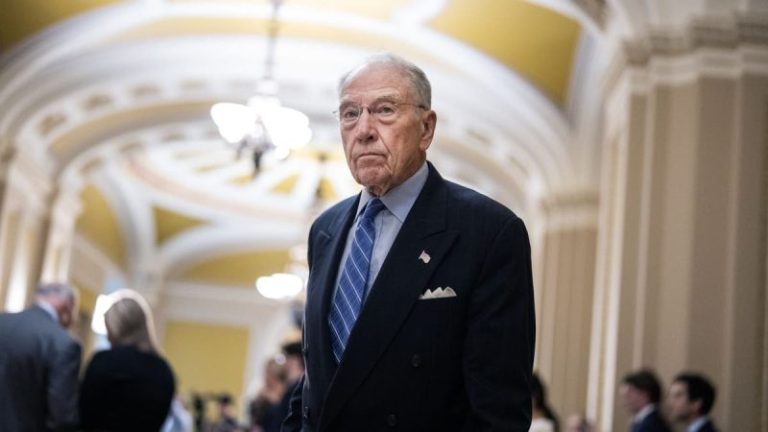
Grassley went on a tear on social media this week, defending his decision to maintain blue slips, which the committee chair has discretion over.

‘U.S. Atty/district judge nominee without a blue slip does not hv the votes to get confirmed on the Senate floor & they don’t hv the votes to get out of cmte,’ the 91-year-old senator wrote. ‘As chairman I set Pres Trump noms up for SUCCESS NOT FAILURE.’

Sen. Thom Tillis, R-N.C., who is among several Republicans who will not vote for a nominee who has not been approved by home state senators, pointed to a statement on social media when asked for comment by Fox News Digital.

‘Chairman Grassley is a principled conservative who wants to keep radical liberals off the bench. Getting rid of the blue slip is a terrible, short-sighted ploy that paves the path for Democrats to ram through extremist liberal judges in red states over the long-term,’ Tillis wrote on X.

Are Democrats to blame?

Trump has thus far secured opposing party blue slips for four nominees. Davis said Trump is facing a unique level of obstruction from Democrats.

‘Every White House does what it can to engage the opposition party, but Democrats have made it clear they’re not interested in working with President Trump, so it’s understandable that his focus has been elsewhere for now,’ Davis said.

Senate Minority Leader Chuck Schumer, D-N.Y., for instance, has refused to give a blue slip to Clayton, the former Securities and Exchange Commission chairman. But Clayton’s ability to win the vote of the federal judges in the Southern District of New York has allowed him to serve as U.S. attorney without confirmation.

Sen. Dick Durbin, D-Ill., Senate Judiciary Committee ranking member, has further complicated the confirmation process by putting a hold on U.S. attorney nominees, which drastically slows, but does not fully block, the process.

Vice President JD Vance, then a senator, did the same for Biden’s nominees toward the end of the last administration.

Trump’s fight with the upper chamber is likely to evolve, especially as higher courts weigh in on Habba’s nomination, which is currently invalid, according to the district court judge’s decision this month. The U.S. Court of Appeals for the Third Circuit has set a briefing schedule in the case that stretches through October, but eventually the Supreme Court could also chime in on whether Trump’s manner of sidestepping the Senate is constitutional. 

This post appeared first on FOX NEWS