Archive

July 2025

Browsing

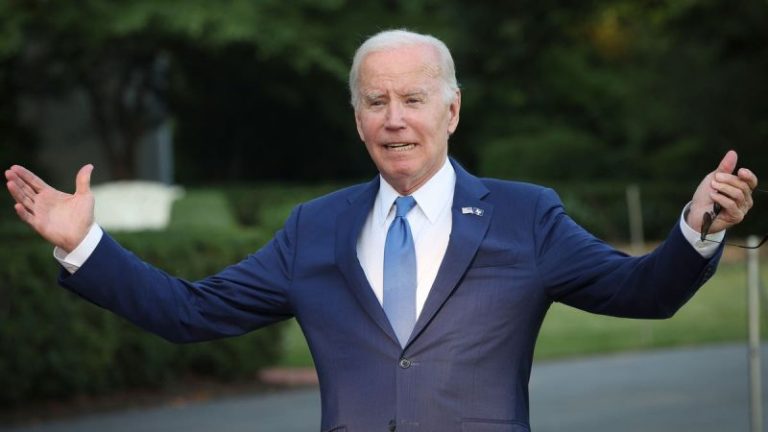
Former White House physician Kevin O’Connor, who served as doctor to former President Joe Biden, requested a delay to his upcoming testimony before the House Oversight Committee this week.

O’Connor was scheduled to testify on Wednesday, but is now in a disagreement with the committee over the scope of the questions he will be expected to answer during his testimony. The committee, led by Chairman James Comer, R-Ky., is interviewing the doctor as part of its investigation into Biden’s mental fitness and his administration’s use of an autopen.

A lawyer for O’Connor requested the testimony be delayed to July 28 or August 4 in a letter to Comer.

‘Dr. O’Connor has legal and ethical obligations that he must satisfy and for which violations carry serious consequences to him professionally and personally,’ the letter says.

‘We are unaware of any prior occasion on which a Congressional Committee has subpoenaed a physician to testify about the treatment of an individual patient.  And the notion that a Congressional Committee would do so without any regard whatsoever for the confidentiality of the physician-patient relationship is alarming.’

A spokesman for the Oversight Committee replied in a statement that O’Connor and his legal team were merely trying to ‘stonewall’ the process. The committee is planning to move forward with Wednesday’s testimony, which O’Connor faces a subpoena to attend.

The committee said O’Connor is welcome to object to individual questions during his testimony. But O’Connor is not allowed, in the committee’s view, to delay or decline a congressional subpoena due to concerns over questions about potentially privileged information.

The debate over O’Connor’s testimony comes weeks after a former top aide to Biden, Neera Tanden, told the Oversight Committee that she was authorized to direct autopen signatures but was unaware of who in the president’s inner circle was giving her final clearance.

During Tanden’s interview before Congress last month, which lasted more than five hours, she told lawmakers that, in her role as staff secretary and senior advisor to the former president between 2021 and 2023, she was authorized to direct autopen signatures on behalf of Biden, an Oversight Committee official told Fox News.

‘Ms. Tanden testified that she had minimal interaction with President Biden, despite wielding tremendous authority,’ Comer said at the time. ‘She explained that to obtain approval for autopen signatures, she would send decision memos to members of the President’s inner circle and had no visibility of what occurred between sending the memo and receiving it back with approval. Her testimony raises serious questions about who was really calling the shots in the Biden White House amid the President’s obvious decline. We will continue to pursue the truth for the American people.’

Fox News’ Kelly Phares and Madeleine Rivera and the Associated Press contributed to this report.

This post appeared first on FOX NEWS

I like to trade stocks that are relative leaders and belong to industry groups that are leaders as well. For the past 2-3 months, much has been written about and discussed with respect to semiconductors ($DJUSSC), software ($DJUSSW), electrical components & equipment ($DJUSEC), electronic equipment ($DJUSAI), recreational services ($DJUSRQ), travel & tourism ($DJUSTT), etc. These groups were laggards prior to showing absolute and relative strength and, many times, it’s the absolute strength (think breakout) that triggers money flows into that particular area of the market.

With that in mind, where’s one area that we could see upcoming strength during the summer months?

Computer Hardware

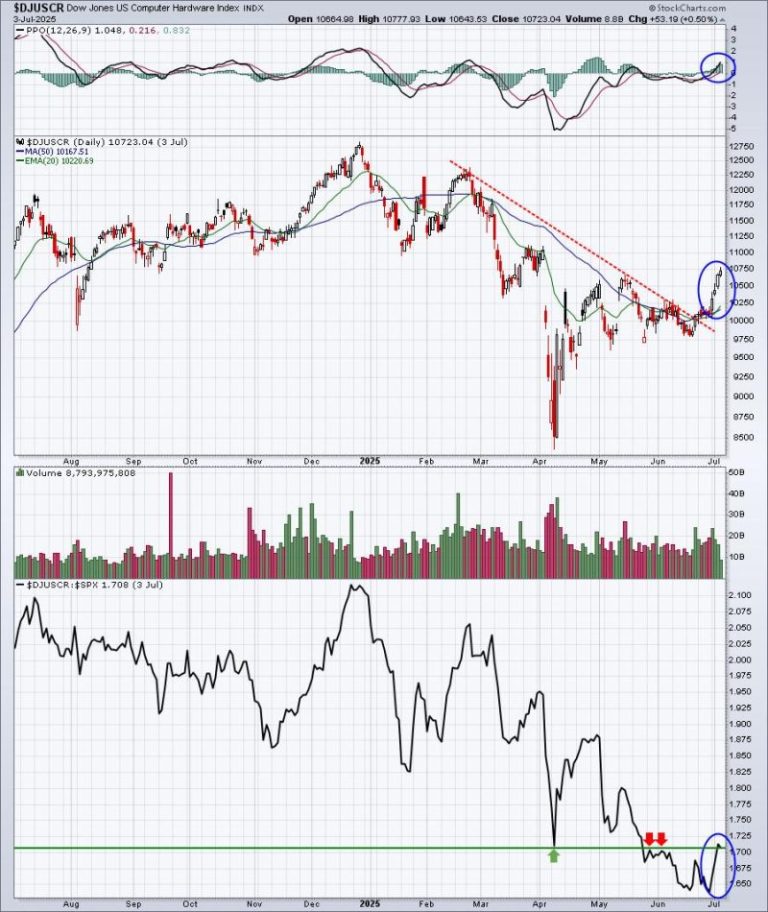
I know this group has been out of favor, but that seemed to change last week:

Its absolute downtrend seems to have been broken and we saw a glimpse of solid relative strength. Seasonality also leads me to believe that this run could very well just be getting started. Check this out:

Over the past 20 years, the DJUSCR has crushed the S&P 500 during the months of July and August. It’s easily been the group’s best two calendar months historically. These two months have consistently been great months for computer hardware stocks as they’ve each gained ground in roughly 3 out of every 4 years. Apple, Inc. (AAPL), the leading computer hardware stock, absolutely loves the months of July and August.

I expect last week’s rally to continue right up to AAPL’s earnings report on July 31st, and possibly beyond.

I’ll be featuring one other computer hardware stock in our FREE EB Digest newsletter on Monday morning that has CRUSHED the S&P 500 during July and August historically and it boasts one of the strongest charts in technology since the April low. If you’re not already an EB Digest subscriber, simply CLICK HERE to provide your name and email address. I’ll get that chart out to you first thing tomorrow morning!

Happy trading!

Tom

Here’s a quick recap of the crypto landscape for Monday (July 7) as of 9:00 am UTC.

Get the latest insights on Bitcoin, Ethereum and altcoins, along with a round-up of key cryptocurrency market news.

Bitcoin and Ethereum price update

Bitcoin (BTC) is priced at US$108,960, trading flat in the last 24 hours. The day’s range for the cryptocurrency brought a low of US$108,077 and a high of US$109,574.

Bitcoin price performance, July 7, 2025.

Chart via TradingView

Ethereum (ETH) is priced at US$2,581.84, up by 1.8 percent over the past 24 hours. Its lowest valuation as of Monday was US$2,513.50 and its highest was US$2,598.09.

Altcoin price update

  • Solana (SOL) was priced at US$152.49, up by three percent over 24 hours. Its highest valuation as of Monday was US$153.27, and its lowest was US$148.10.
  • XRP was trading for US$2.27, trading flat in the past 24 hours. The cryptocurrency’s lowest valuation was US$2.25 and its highest was US$2.29.
  • Sui (SUI) is trading at US$2.91, trading flat over the past 24 hours. Its lowest valuation was US$2.88 and its highest was US$2.96.
  • Cardano (ADA) is priced at US$0.5877, up by 1.2 percent in the last 24 hours. Its lowest valuation as of Monday was US$0.5776 and its highest was US$0.5922.

Today’s crypto news to know

SEC’s crypto ETF guidance signals mainstream shift

The US Securities and Exchange Commission took a major step toward regulating crypto exchange-traded products with its first formal guidance on crypto ETP disclosures, according to a Reuters analysis.

Issued last week, the 12-page document clarifies how issuers should describe risks and custody arrangements in “plain English,” which could speed up approval of dozens of new crypto ETFs tied to Solana, XRP, and even Trump’s meme coin.

The SEC is also developing a more standardized listing rule to replace the case-by-case exemptions that currently delay launches. That change could shrink approval timelines from 240 days to as little as 75.

Insiders expect the next round of SEC guidance, potentially out by autumn, to fully reshape how crypto funds come to market.

Musk’s America Party goes all-in on Bitcoin, calls fiat ‘hopeless’

Elon Musk confirmed that his newly formed America Party will officially embrace Bitcoin after declaring that “fiat is hopeless” in a post on X.

The move follows Musk’s earlier hints at increasing his own Bitcoin exposure and praising Bitcoin as a hedge against traditional currency.

Musk previously supported Donald Trump’s reelection campaign and even headed the Department of Government Efficiency before splitting with Trump over his budget bill, leading to the creation of the America Party.

The shift could inject more digital asset discussions into US politics as Musk tries to build a third-party movement.

Despite hype from Dogecoin supporters, no plans for DOGE adoption were announced.

Metaplanet boosts Bitcoin stash past 15,500 BTC in aggressive buying spree

Japan’s Metaplanet disclosed this week that it purchased another 2,205 BTC at an average price of 15.64 million yen per coin, spending around US$213 million.

This purchase brings the firm’s total bitcoin holdings to 15,555 BTC, making Metaplanet one of the world’s largest corporate holders of the asset.

The company tracks a proprietary metric called BTC Yield, measuring the effect of share dilution on per-share bitcoin value.

For the second quarter, Metaplanet reported a BTC Yield of 95.6 percent, down from 309.8 percent the previous quarter, but still strong enough to highlight aggressive growth.

Metaplanet’s total BTC investment now tops US$1.38 billion.

Securities Disclosure: I, Giann Liguid, hold no direct investment interest in any company mentioned in this article.

Securities Disclosure: I, Meagen Seatter, hold no direct investment interest in any company mentioned in this article.

This post appeared first on investingnews.com

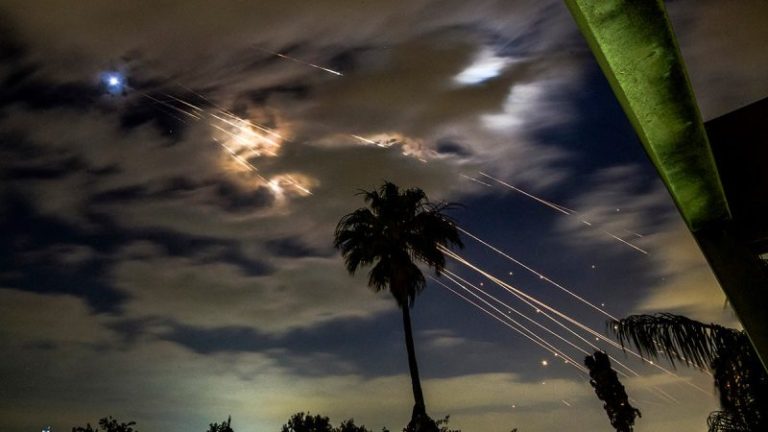
Israel exchanged missile fire with Iran-backed Houthi rebels in Yemen on Monday, targeting the group’s ports and other facilities.

Israel’s initial strikes came in reaction to a suspected Houthi attack on a Liberian-flagged ship in the Red Sea. The vessel was targeted with explosives and small arms fire, causing it to take on water and forcing the crew to abandon ship. The Houthis have not yet claimed responsibility for the attack. Israel’s military issued a warning prior to its attack, which targeted ports at Hodeida, Ras Isa and Salif.

‘These ports are used by the Houthi terrorist regime to transfer weapons from the Iranian regime, which are employed to carry out terrorist operations against the state of Israel and its allies,’ the Israeli military said.

The Houthis responded in kind when Israeli missiles started falling, but Israel reported no casualties from the attack.

The Israeli attack also targeted the Galaxy Leader, a vessel seized by the Houthis in 2023. The IDF said the ship had been ‘fitted with a radar system to track international vessels for terror operations.’

Israeli Defense Minister Israel Katz threatened further strikes if Houthi aggression continues in the Red Sea or elsewhere.

‘What’s true for Iran is true for Yemen,’ Katz said in a statement. ‘Anyone who raises a hand against Israel will have it cut off. The Houthis will continue to pay a heavy price for their actions.’

Meanwhile, Houthi military spokesman Brig. Gen. Yahya Saree said the group is ‘fully prepared for a sustained and prolonged confrontation’ and plans to maintain its ‘naval blockade.’

U.S. Army Gen. Michael Kurilla told lawmakers in the House Armed Services Committee last month that Iran is the number one reason the Houthis remain a threat, adding the terrorist network ‘would die on the vine without Iranian support.’

News of Monday’s exchange comes just hours before President Donald Trump and Israeli Prime Minister Benjamin Netanyahu are set to meet at the White House.

The two leaders are expected to discuss the future of Gaza, with Israel insisting Hamas must be removed from the region completely.

The Associated Press contributed to this report

This post appeared first on FOX NEWS

Chinese chain Luckin Coffee opened its first two U.S. locations this week, betting that mobile-only ordering and creative flavors can lure customers away from Starbucks.

Both new Luckin stores are based in Manhattan, and at the midtown location on Wednesday, Sam Liu took a sip of her jasmine cold brew.

“I’ve never tried anything like it,” she said.

I thought I just order at the counter, but I realized everyone was standing around looking at their phone.

Luckin Customer Sam Liu, New York City

Liu said she’d hoped for more seating — the small shop has only three tables — and was initially confused by Luckin’s in-app ordering system, which means customers can’t order directly from a barista.

“I thought I just order at the counter, but I realized everyone was standing around looking at their phone,” Liu said.

Luckin is China’s largest coffee chain, with more than twice as many locations as Starbucks there. Its two New York City stores are its first foray outside Asia, where it has over 24,000 locations across the region. By comparison, there are over 17,000 Starbucks in the United States.

Its CEO, Guo Jinyi, called the U.S. “a strategically important market” for the company’s expansion in a press release heralding the two new locations Wednesday. “We are excited to introduce a diverse and unique coffee experience to American consumers.”

The company, which didn’t respond to a request for comment, has touted its ambitions to expand globally but hasn’t publicly detailed its next moves in the U.S. or other markets.

The chain has gained success overseas through creative drinks like alcohol-infused coffees and fruit lattes, along with its smartphone-centric ordering model. The app-based approach makes it easier to track inventory, send personalized appeals to consumers and serve drinks quickly, said John Zolidis, an analyst who tracks Luckin and Starbucks at the brokerage firm he founded, Quo Vadis Capital.

“Luckin was able to develop an incredible muscle with regard to product innovation, and they have been very creative in China,” he said.

Drink orders ready for pickup or delivery inside one of the Manhattan Luckin shops on Monday.Anthony Behar / Sipa USA via AP

Zolidis said how Luckin fares on Starbucks’ home turf will depend on its ability to differentiate its menu from other major U.S. coffee chains and smaller, independent cafes. Its American lineup already includes distinctive drinks like blood orange cold brew and coconut lattes.

“These orange drinks, or one of their most successful, a coconut cloud latte — that’s how you get trial [customers] from the U.S.,” Zolidis said.

Luckin faced financial troubles during the pandemic. It was delisted from Nasdaq in 2020 after its stock plunged following an internal investigation that found an executive had falsified revenue reports. The company filed for bankruptcy in the U.S. the following year but emerged from proceedings in 2022 and its sales have soared since, reaching $4.7 billion worldwide in fiscal year 2024, a 38.4% increase from 2023.

Luckin was able to develop an incredible muscle with regard to product innovation, and they have been very creative in China.

John Zolidis, Founder, Quo Vadis Capital

Starbucks, by contrast, is struggling in both the U.S. and China. Its same-store sales in the U.S. declined 2% and its sales in China 8% in fiscal year 2024, and it reported in April that its quarterly profit was half of what it pulled in for the same period last year. The Seattle-based chain is reportedly looking to partially sell its business in China while revamping its U.S. strategy to focus on customer experience and human connection, in contrast with Luckin’s model.

“We veered away from, I think, owning the idea of the ‘third place,’ the coffeehouse experience, making sure that the customer was front and center,” Starbucks CEO Brian Niccol told NBC News in June.

A Starbucks spokesperson declined to comment.

Zolidis said that whereas Starbucks aims in both the U.S. and China to appeal to customers looking for higher-end coffee served in an inviting setting, Luckin has successfully positioned itself as the “everyman’s coffee” in China, with low prices and small, grab-and-go storefronts.

After taking the train in from Hoboken, New Jersey, to check out the new one in midtown, Samantha Coy said the trip was worth it. She had enjoyed Luckin in China previously and was eager to order one of its fruit drinks.

“I’m surprised Starbucks hasn’t tried to bring that over to the U.S.,” Coy said. “I hope they stay open.”

Zolidis said he thinks Luckin is well-positioned to gain a foothold in America.

“They’ve been able to operate and grow incredibly quickly in the Chinese market, much faster than I would have thought possible, and they’ve been able to sustain it and develop a strong financial model so they can fund their expansion in the U.S.,” Zolidis said. “They wouldn’t be coming here to try it if they didn’t think they had a shot of owning part of the market.”

This post appeared first on NBC NEWS

The stock markets had a dynamic start to the third quarter, pushing indices to new highs after earlier tariff concerns.

On Monday (June 30), markets generally saw strong gains, with the S&P 500 (INDEXSP:INX) and Nasdaq Composite (INDEXNASDAQ:.IXIC) reaching new record highs in the US while the S&P/TSX Composite Index (INDEXTSI:OSPTX) climbed higher after a last-minute policy reversal to rescind a planned digital services tax targeting US tech firms.

Tuesday (July 1), Canadian markets were closed for Canada Day. As for US markets, following two consecutive days of highs, the S&P and Nasdaq declined on Tuesday (July 1) after a renewed feud between Tesla (NASDAQ:TSLA) CEO Elon Musk and US President Donald Trump sent Tesla shares down by over 5 percent.

However, tech stocks boosted the performance of both Canadian and US markets on Wednesday (July 2) and Thursday (July 3) after export restrictions to China were lifted and the US labor market reported better-than-expected unemployment data.

US markets were closed on Friday (July 4) for a holiday, while Canadian markets ended the day slightly positive.

1. Meta announces AI restructure, continues talent acquisition

Last weekend, reports surfaced that Meta Platforms (NASDAQ:META) has hired four additional researchers from OpenAI, bringing the total number of high-profile AI talent poached from other tech labs to 13, according to a tweet from former Scale AI CEO Alexandr Wang, who was recently recruited as Meta’s Chief AI Officer.

Then, in an internal memo to employees on Monday, Meta CEO Mark Zuckerberg unveiled the company was restructuring its AI division under the name Meta Superintelligence Labs. According to the memo, which was reviewed by Bloomberg, the new division will be led by Wang and one of its commitments is ‘developing AI ‘superintelligence’ or systems that can complete tasks as well as or even better than humans.’

Meta has reportedly offered researchers contracts and signing bonuses worth up to US$100 million; however, Chief Technology Officer Andrew Bosworth has pushed back on those reports, claiming the figures are inflated.

Helen Toner, a former OpenAI board member and director of strategy at Georgetown’s Center for Security and Emerging Technology, told Bloomberg TV’s Haslinda Amin on Thursday that Meta’s bid to become an AI leader would be “difficult” considering its track record of internal dysfunction and questions around the return on its massive talent spending.

“Meta has started to get a reputation of having a little bit of a dysfunctional AI team, not really having its organizational structure set up in a way that really lets them succeed and innovate. And what I think we’re seeing here is CEO Mark Zuckerberg really stepping in and saying, well, we have to do something differently. We need a big new push, we need a big new effort,’ she said.

‘I think (Meta is) really trying to start something new, to pour enormous amounts of financial resources into that. So the question (to watch) is six months from now, 12 months from now, is that paying off for them?’

2. Apple considers third-party AI for Siri overhaul

Apple (NASDAQ:AAPL) is reportedly in active discussions with Anthropic and OpenAI to integrate their foundation models into an overhauled version of its voice assistant Siri, a significant pivot from the company’s in-house approach to AI. According to people familiar with the discussions who spoke to Bloomberg, Apple has asked both companies to train versions of their models that could be tested on Apple’s infrastructure, the publication reported Monday.

Apple announced plans to release a new version of its voice assistant at its Worldwide Developers Conference in 2024. The release was slated for 2026, but the company has run into multiple engineering snags and delays, and ultimately replaced John Giannandrea with Mike Rockwell as the new Siri chief executive.

Rockwell and software engineering head Craig Federighi launched an evaluation, instructing staff to assess Siri’s performance using third-party tech, including Anthropic’s Claude, OpenAI’s ChatGPT and Alphabet’s (NASDAQ:GOOGL) Gemini.

According to Bloomberg’s sources, the team found Anthropic’s technology most promising for Siri, leading Apple’s vice president of corporate development to open discussions with Anthropic.

Bloomberg’s sources maintain that the development of an in-house model is still active, and Apple hasn’t made a final decision on using third-party models.

Apple shares closed up 6.24 percent for the week.

Apple’s share price performance, June 30 to July 3, 2025.

3. Oracle and OpenAI ink massive computing deal

OpenAI will rent roughly 4.5 gigawatts of computing power from Oracle (NYSE:ORCL) as part of the Stargate Project, according to sources for Bloomberg. The news follows a US$30 billion single cloud deal announced on Monday with an unnamed customer.

The Stargate energy deal is reportedly a component of that larger contract.

Sources added that Oracle will develop multiple data centers in the US, considering sites in Texas, Michigan, Wisconsin and Wyoming, and that the company will expand its recently built center in Abilene, Texas, to accommodate about two gigawatts of power capacity.

This collaboration underscores the escalating demand for high-performance computing necessary to train and operate advanced AI models. OpenAI, a leader in AI research and development, requires immense computational resources to fuel its projects, including large language models and other sophisticated AI applications.

The Stargate initiative positions Oracle as a crucial enabler of this next generation of AI innovation, solidifying its role in the evolving cloud and AI ecosystem. The long-term implications of this partnership could see a significant shift in how AI companies acquire and manage their computational infrastructure, potentially paving the way for more dedicated and extensive cloud partnerships in the future.

Oracle’s share price performance, July 1 to July 3, 2025.

4. CoreWeave deploys first Nvidia GB300-powered AI server

CoreWeave (NASDAQ:CRWV) said it has received the first AI server system built around NVIDIA’s (NASDAQ:NVDA) ultra-powerful GB300 Grace Blackwell AI chip.

The server is deployed within Dell’s (NYSE:DELL) integrated rack-scale system — a turnkey AI infrastructure platform combining compute, networking and cooling — and features 72 of Nvidia’s GB200 chips.

CoreWeave said it will install the cutting-edge hardware in the US and roll out more servers over time. The company will offer the server as part of its AI cloud platform, allowing clients like OpenAI to train and deploy massive, next-generation AI models with faster speeds and greater efficiency.

In the announcement, CoreWeave claimed the NVIDIA GB300 NVL72 significantly boosts AI reasoning performance, offering a 10 times improvement in user responsiveness and five times better throughput per watt than the Hopper server. This translates to an increase of fifty times in reasoning model inference output, enabling faster, more complex AI models.

5. US lifts EDA software export restrictions to China

License requirements for design software sales in China were lifted this week as part of a trade deal between the US and China.

On July 2, the US Commerce Department told Synopsys (NASDAQ:SNPS), Cadence Design Systems (NASDAQ:CDNS) and Siemens (XETR:SIE), three of the world’s leading design software providers, that they would no longer need to seek government licenses to conduct business in China.

Official announcements from the companies confirmed they would be resuming business with Chinese counterparts, sending each of their stock prices up between 3 and 6 percent.

The US government restricted sales of electronic design automation (EDA) tools to China in late May as a response to China’s decision to limit shipments of essential rare earth minerals. Last week, the two countries reached a trade agreement that would re-allow shipments of EDA software after Beijing speeds up approvals of critical mineral exports to the US.

Securities Disclosure: I, Meagen Seatter, hold no direct investment interest in any company mentioned in this article.

This post appeared first on investingnews.com
Iran is preparing its next step in what one security expert warns remains its chief objective: developing a nuclear weapon.

‘Repair, reconstitute and rebuild is going to be the modus operandi of the Islamic Republic of Iran,’ Behnam Ben Taleblu, Senior Director of the Foundation for Defense of Democracies’ Iran Program told Fox News Digital. ‘It just depends on how are they going to be doing it? While flirting with the international community? Are they going to go dark totally altogether?

‘All of this remains to be seen,’ he added.

Spokesman for the regime, Fatemeh Mohajerani, confirmed this week that the Fordow, Isfahan and Natanz nuclear sites had been ‘seriously damaged’ following the U.S. and Israeli strikes on Iran’s nuclear program last month. 

Questions remain over the extent of damage that was incurred, as well as skepticism over whether Iran was able to move any enriched uranium or centrifuges away from the heavily guarded sites prior to the strikes. 

Though the Trump administration said on Wednesday that it had ‘obliterated’ the three facilities it struck, and has fervently rejected reports suggesting that Iranian officials may have been able to transfer some elements of the regime’s coveted nuclear program, Israeli officials confirmed this week that they are continuing to monitor the situation closely.

Experts in the U.S. and Israel have said they believe Iran is still assessing the extent of the damage from the ‘bunker busting’ bombs, and that the regime will look to recover and repair what it can — meaning it may be looking to buy time.

‘No doubt, the regime will still have a diplomatic strategy designed to rope-a-dope anybody, and to find as much time as possible for this government to do that,’ Ben Taleblu said.

The Iranian regime this week suggested it remained open to negotiations with the U.S. after President Donald Trump signaled that the talks could begin as soon as next week, though multiple Iranian officials said that that timeframe was overly ambitious. 

‘I don’t think negotiations will restart as quickly as that,’ Iranian Foreign Minister Abbas Araghchi said in a CBS News interview. ‘The doors of diplomacy will never slam shut.’ 

But the regime also took steps to further hinder the UN nuclear watchdog — which is tasked with tracking all nation’s nuclear programs — and suspended all interaction with the International Atomic Energy Agency (IAEA) on Wednesday. 

That same day, the State Department condemned the move, and spokesperson Tammy Bruce said it was ‘unacceptable that Iran chose to suspend cooperation with the IAEA at a time when it has a window of opportunity to reverse course and choose a path of peace and prosperity.’

Iran has limited IAEA access in the past and Ben Taleblu argued Tehran will likely look to do this again as it attempts to hold on to any bargaining chip it can.

‘The Islamic Republic of Iran’s next step, and likely most dangerous capability right now, is its diplomatic capability,’ the Iranian security expert argued. ‘This is the capability of the regime to either enter negotiations with a weak hand and leave with a strong hand, or try to prevent a military victory of its adversaries from becoming a political victory. 

‘If negotiations do take place between the U.S. and the Iranians, be they direct or indirect, the Iranians are going to be dangling IAEA access. This is already their most important weapon,’ he added. 

Ben Taleblu explained that using the IAEA as a bargaining chip not only enables Iran to play for time as it looks to re-establish its nuclear program, but to sow division in the U.S. by creating uncertainty. 

‘By diminishing the monitoring and by circumscribing and even cutting IAEA access to these facilities, the regime is trying to make America have to rely on intelligence alone,’ he said. ‘And as you see from the very politicized debates over the battle damage assessment, relying on intelligence alone without sources on the ground inspecting the sites, inspecting the facilities, documenting the fissile material, can lead to drastically different conclusions being taken by similar but not the same intelligence organizations or representatives.’

Ultimately, Iran is not going to give up on its nuclear ambitions, Ben Taleblu warned, noting that Tehran’s security apparatus completely changed during its war with Iraq in the 1980s. 

‘Everything that we face from the regime that is a security threat was started then — the ballistic missile program, the drone program, the maritime aggression, the transnational terrorist apparatus and the nuclear program all have their origins in the 1980s,’ he said.  ‘By resurrecting this nuclear program, the Islamic Republic was not engaging in a science fair experiment. 

‘The Islamic Republic was seeking an ultimate deterrent,’ Ben Taleblu continued. ‘It was seeking an ultimate deterrence because it had a vision for what the region and the world should look like, and it was willing to put foreign policy muscle and the resources of its state behind that vision.’

The expert on the Iranian regime warned that Iran’s 40-year ‘obsession’ with developing its nuclear program to achieve its geopolitical aims is not going to change because of U.S. military intervention. 

This post appeared first on FOX NEWS

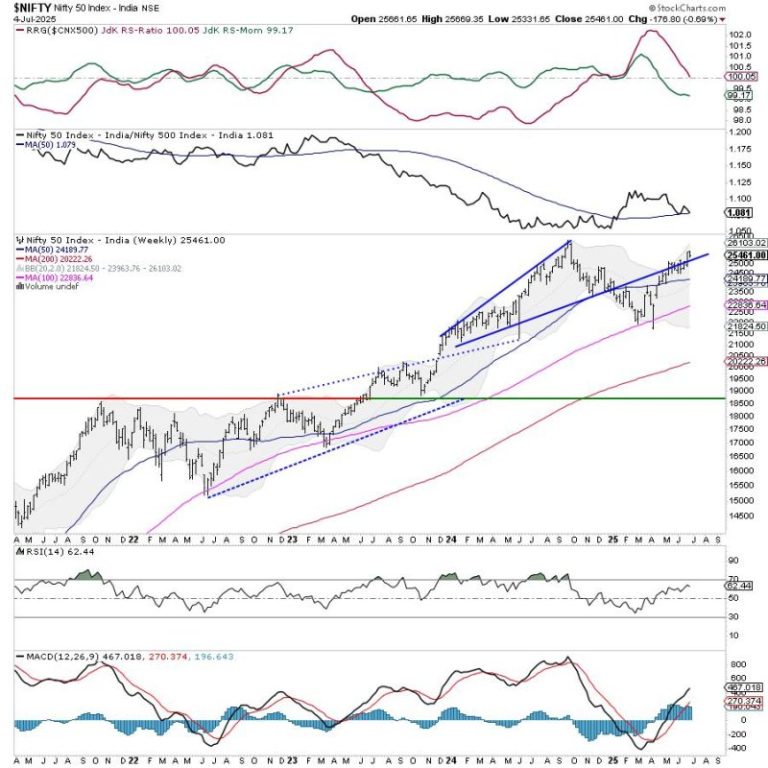
After a strong move in the week before this one, the Nifty spent the last five sessions largely consolidating in a very defined range. The markets traded with a weak underlying bias and lost ground gradually over the past few days; however, the drawdown remained quite measured and within the expected range. As the markets consolidated, the trading range got narrower. The Nifty moved in a 337-point range during the week. While the Index formed a near-similar high, it marked a much higher low. The volatility also retraced; the India VIX came off by 0.59% to 12.31. While showing no intention to trend higher, the headline Index closed with a net weekly loss of 176.80 points (-0.69%).

The Nifty has created an intermediate resistance zone between 25600 and 25650. A trending move on the upside would happen only if the Nifty is able to take out this zone on the upside convincingly. Until that happens, we will see the Nifty continuing to consolidate with 25100 acting as support. This is the prior resistance level, which is expected to act as support in case of any corrective retracement. So long as the Nifty is inside the 25000-25650 zone, it is unlikely to develop any sustainable directional bias on either side.

Friday was a trading holiday in the US. Because of this, we will not have any overnight cues to deal with on Monday. The Indian markets may see a stable and quiet start. The levels of 25650 and 25800 are likely to act as probable resistance points. Support levels come in at 25250 and 25000.

The weekly MACD is bullish and remains above its signal line. The weekly RSI is 62.40; it stays neutral and does not show any divergence against the price. No major formation was noticed on the candles.

The pattern analysis of the weekly chart reveals that after breaking above the rising trendline resistance and moving past the 25000-25150 zone, the Nifty consolidated after trending higher for four consecutive days. Over the past week, it gave up a portion of its gains and consolidated at higher levels. In the process, it has dragged its support level higher to 25000. As long as the Index remains above this point, the breakout and the resumption of the upmove observed in the preceding week remain valid and intact.

Overall, it is expected that the Nifty will remain within the 25000-25650 range over the coming week. The markets are unlikely to develop any directional bias unless they move past the 25650 level or violate the 25000 level. Sector rotation within the market is very much visible; it would be imperative to efficiently rotate sectors and stay invested in those that show improved relative strength and a promising technical setup. We are likely to see improved performance in the Auto, Energy, IT, and broader markets, among other sectors. It is also strongly recommended to protect profits here, where the stocks have run up hard. Any aggressive shorting should be avoided as long as the Nifty stays above the 25000 level. A cautiously positive approach is advised for the coming week.


Sector Analysis for the coming week

In our look at Relative Rotation Graphs®, we compared various sectors against the CNX500 (NIFTY 500 Index), representing over 95% of the free-float market cap of all the listed stocks. 

Relative Rotation Graphs (RRG) show that the Nifty PSU Bank Index and the Midcap 100 Index are the only two groups that are inside the leading quadrant. They are likely to outperform the broader markets relatively.

The Nifty Infrastructure Index is experiencing an improvement in its relative momentum while it remains within the weakening quadrant. Additionally, the PSE, Nifty Bank, and the Financial Services Index are located within the weakening quadrant. While individual stock-specific performance may not be ruled out, the overall relative performance may take a backseat.

The Commodities Index and the Services Sector Index have rolled into the lagging quadrant. The Consumption, Pharma, and the FMCG Indices also continue to languish inside the lagging quadrant. The Metal Index is showing a sharp improvement in its relative momentum against the broader markets, while staying within the lagging quadrant.

The IT, Energy, Media, Realty, and Auto Indices are inside the Improving quadrant. They continue to rotate firmly while improving their relative performance against the broader Nifty 500 Index.


Important Note: RRG charts show the relative strength and momentum of a group of stocks. In the above Chart, they show relative performance against NIFTY500 Index (Broader Markets) and should not be used directly as buy or sell signals.  


Milan Vaishnav, CMT, MSTA

Consulting Technical Analyst

www.EquityResearch.asia | www.ChartWizard.ae

On Monday (June 30), Statistics Canada released its natural resource indicator report for the first quarter of 2025.

The data shows a 1.6 percent growth quarter-over-quarter in the real gross domestic product (GDP) of the sector during the three-month period, indicating that the sector outpaced the broader economy, which posted an increase of just 0.5 percent.

The energy subsector led the way with a 2.2 percent gain, driven by increases of 2 percent in crude oil and 3.4 percent in electricity.

The minerals and mining sector increased by just 0.4 percent overall. Within it, the manufacturing of metallic mineral products grew 4 percent, and non-metallic mineral extraction rose 3.2 percent. On the other hand, metallic mineral extraction declined by 2.9 percent

Although real GDP increased, exports declined at the start of the year. Energy exports fell by 1.8 percent, due to a 12.4 percent decrease in outgoing refined petroleum products. Similarly, mineral and mining exports were also down by a more modest 0.9 percent.

South of the border, the “One Big Beautiful Bill” was passed by the US Congress on Thursday (July 3). The legislation is a cornerstone policy of President Donald Trump’s economic policy and includes several significant tax and spending cuts.

Among the provisions is an extension of US$4.5 trillion in tax breaks originally enacted by Trump in 2017 during his first term.

The package will increase defense and national security spending, including significantly increased funding for Immigration and Customs Enforcement and money earmarked for the development of the “Golden Dome” missile defense system.

To offset the decrease in tax income and increase in spending, the government made US$1.2 trillion in cuts to Medicaid and food stamps and clawed back green energy tax credits.

Critics of the bill have warned that it would result in increased deficit spending by the government, as shortfalls are expected to add more than US$3.3 trillion to the federal deficit over the next decade.

Markets and commodities react

In Canada, markets were closed on Tuesday (July 1) for the Canada Day holiday. Equity markets saw moderate gains this week with the S&P/TSX Composite Index (INDEXTSI:OSPTX) rising 1.24 percent to close at 27,036.16 on Friday. The S&P/TSX Venture Composite Index (INDEXTSI:JX) fared better, gaining 3.9 percent to 755.22, while the CSE Composite Index (CSE:CSECOMP) climbed 1.9 percent to 120.92.

Markets in the US also had a shortened week and were closed on Friday for the July 4 holiday. US equities were also in positive territory this week, with the S&P 500 (INDEXSP:INX) gaining 2.09 percent to close Thursday at 6,279.36, the Nasdaq 100 (INDEXNASDAQ:NDX) climbing 1.7 percent to 22,866.97 and the Dow Jones Industrial Average (INDEXDJX:.DJI) rising 0.77 percent to 44,828.54.

The gold price rose 1.85 percent to US$3,333.90 by Friday at 4 p.m. EDT, while the silver price ended the week up 2.39 percent to US$36.85.

In base metals, the COMEX copper price was unchanged this week at US$5.12 per pound. Meanwhile, the S&P GSCI (INDEXSP:SPGSCI) gained 1.49 percent to close at 552.55.

Top Canadian mining stocks this week

How did mining stocks perform against this backdrop?

Take a look at this week’s five best-performing Canadian mining stocks below.

Stock data for this article was retrieved at 4 p.m. EDT on Friday using TradingView’s stock screener. Only companies trading on the TSX, TSXV and CSE with market capitalizations greater than C$10 million are included. Mineral companies within the non-energy minerals, energy minerals, process industry and producer manufacturing sectors were considered.

1. Mkango Resources (TSXV:MKA)

Weekly gain: 90 percent
Market cap: C$147.17 million
Share price: C$0.57

Mkango Resources is a rare earths exploration and development company focused on advancing rare earths mining and recycling projects.

The company owns the Songwe Hill rare earths project in Southeast Malawi. The property comprises 11 retention licenses and has undergone historic exploration dating back to the 1980s.

A July 2022 feasibility study for the property demonstrated economic viability with a post-tax net present value of US$559 million, an internal rate of return of 31.5 percent and a payback period of 2.5 years.

The report was based on a February 2019 mineral reserve estimate that reported measured and indicated total rare earth oxide (TREO) resources of 297,400 metric tons from 21.03 million metric tons of ore with an average grade of 1.5 percent and inferred resources of 366,200 metric tons of TREOs from 27.54 million metric tons of ore with an average grade of 1.33 percent.

The company is also developing the Pulawy rare earth separation plant in Poland in partnership with Grupa Azoty Zakłady Azotowe. Once complete, the plant is expected to produce 2,000 metric tons per year of neodymium, praseodymium and didymium oxides. It will also produce 50 metric tons per year of dysprosium and terbium oxides.

Additionally, Mkango holds a 79.4 percent interest in Maginito, which owns HyProMag, a company specializing in the recycling of rare earth magnets. The remaining 20.6 percent interest is held by CoTec Holdings (TSXV:CTH,OTCQB:CTHCF).

Shares in Mkango were up this week after the company announced on Thursday that it had entered into a definitive business combination agreement with Crown PropTech Acquisitions. The company stated that its subsidiary, Lancaster Exploration, and other subsidiaries would merge with Crown PropTech to create what it describes as a vertically integrated, global rare earths platform that incorporates Songwe Hill and the Pulawy separation plant. The combined entity will be named Mkango Rare Earths and trade on the Nasdaq.

Following the deal, which is targeted to close in Q4, Mkango will focus on its rare earths recycling business.

2. Lithium South (TSXV:LIS)

Weekly gain: 50 percent
Market cap: C$55.61 million
Share price: C$0.18

Lithium South is an exploration and development company working to advance its Hombre Muerto North lithium brine project in Argentina. The property consists of nine concessions covering a land package of 5,687 hectares.

According to its April 2024 preliminary economic assessment, the company is planning to install production wells at the Tramo, Natalia Maria and Alba Sabrina concessions. The assessment demonstrated project economics with a post-tax net present value of US$934 million, an internal rate of return of 31.6 percent and a payback period of 2.5 years.

The included mineral resource estimate for the three concessions reported a combined measured and indicated lithium resource of 297,400 metric tons from 404.1 million cubic meters of brine with an average concentration of 736 milligrams per liter.

The most recent news from Lithium South was released on June 25, when the company provided an update on its environmental impact assessment. Lithium South said that it had received a response from the mining secretariat of the Salta Province regarding the assessment and was in the process of responding to obtain final approval, which would allow the company to construct a pilot plant for its definitive feasibility study.

3. Oceanic Iron Ore (TSXV:FEO)

Weekly gain: 46.81 percent
Market cap: C$55.61 million
Share price: C$0.345

Oceanic Iron Ore is an exploration and development company working to advance its Ungava Bay iron projects in Northern Québec, Canada.

The properties consist of 3,000 claims covering a total land package of 1,500 square kilometers across three project areas: Hopes Advance, Morgan Lake and Roberts Lake.

A January 2020 preliminary economic assessment for Hopes Advance presented project economics, showing a post-tax net present value of US$1.4 billion, an internal rate of return of 16.8 percent and a payback period of 6.7 years.

The report also included a mineral reserve estimate for Hopes Advance with a measured and indicated resource of 515 million metric tons of iron concentrate from 1.39 billion metric tons of ore with an average grade of 32.1 percent.

On Monday, Oceanic announced it settled C$139,666 in accrued interest from several debentures by issuing common shares at a price of C$0.24. While its share price didn’t move much on that news, it picked up steam significantly in the latter half of the week.

4. Excellon Resources (TSXV:EXN)

Weekly gain: 44.44 percent
Market cap: C$55.61 million
Share price: C$0.325

Excellon Resources is an exploration and development company that is advancing its recently acquired Mallay silver mine in Peru back into production.

Mining at the site produced 6 million ounces of silver, 45 million pounds of zinc and 35 million pounds of lead between 2012 and 2018 before the operation was placed on care and maintenance.

On June 24, Excellon announced that it had completed its acquisition of Minera CRC, and its Mallay mine and Tres Cerros gold-silver project in Peru.

Excellon began the court-supervised acquisition process in October 2024. On March 11, Excellon announced that it had entered into a definitive agreement with Adar Mining and Premier Silver, which resolved any outstanding disputes between Adar, Premier, and Minera, and paved the way to complete the transaction.

In the June release, the company stated that it will immediately commence the next phase of its strategy to restart the mine. As Mallay is fully permitted with infrastructure in place, Excellon is aiming for run-rate silver production in Q2 of next year.

Additionally, the company announced on Thursday that it had appointed Mike Hoffman to its board of directors. Hoffman has been in the mining sector for over 35 years, and has experience with developing mines in Latin America.

5. Benz Mining (TSXV:BZ)

Weekly gain: 40.54 percent
Market cap: C$121.72 million
Share price: C$0.52

Benz Mining is a gold exploration company that is focused on advancing projects in Québec and Western Australia.

Its flagship Eastmain project consists of an 8,000 hectare property located in Central Québec within the Upper Eastmain Greenstone belt. The most recent mineral resource estimate from May 2023 reported an indicated resource of 384,000 ounces of gold from 1.3 metric tons of ore grading 9 g/t gold, and an inferred resource of 621,000 ounces of gold from 3.8 metric tons grading 5.1 g/t.

Earlier this year, Benz acquired the Glenburgh and Mt Egerton gold projects in Western Australia from Spartan Resources (ASX:SPR). It has spent much of 2025 exploring Glenburgh, which covers an area of 786 square kilometers and features 50 kilometers of strike. The site hosts six priority extension targets and 5 kilometers of exploration trend with over 100 parts per billion gold.

A November 2024 mineral resource estimate for Glenburgh showed an indicated and inferred resource of 510,000 ounces of gold from 16.3 million metric tons of ore with an average grade of 1 g/t gold.

On June 30, the company reported that it had encountered high-grade intercepts during its drill program at Glenburgh. One hole returned a grade of 2.9 g/t over 72 meters which included an intersection of 5.1 g/t over 39 meters at a depth of 319 meters.

The company stated that the results represent a significant step forward in “understanding and expanding the gold system.”

FAQs for Canadian mining stocks

What is the difference between the TSX and TSXV?

The TSX, or Toronto Stock Exchange, is used by senior companies with larger market caps, and the TSXV, or TSX Venture Exchange, is used by smaller-cap companies. Companies listed on the TSXV can graduate to the senior exchange.

How many mining companies are listed on the TSX and TSXV?

As of February 2025, there were 1,572 companies listed on the TSXV, 905 of which were mining companies. Comparatively, the TSX was home to 1,859 companies, with 181 of those being mining companies.

Together the TSX and TSXV host around 40 percent of the world’s public mining companies.

How much does it cost to list on the TSXV?

There are a variety of different fees that companies must pay to list on the TSXV, and according to the exchange, they can vary based on the transaction’s nature and complexity. The listing fee alone will most likely cost between C$10,000 to C$70,000. Accounting and auditing fees could rack up between C$25,000 and C$100,000, while legal fees are expected to be over C$75,000 and an underwriters’ commission may hit up to 12 percent.

The exchange lists a handful of other fees and expenses companies can expect, including but not limited to security commission and transfer agency fees, investor relations costs and director and officer liability insurance.

These are all just for the initial listing, of course. There are ongoing expenses once companies are trading, such as sustaining fees and additional listing fees, plus the costs associated with filing regular reports.

How do you trade on the TSXV?

Investors can trade on the TSXV the way they would trade stocks on any exchange. This means they can use a stock broker or an individual investment account to buy and sell shares of TSXV-listed companies during the exchange’s trading hours.

Article by Dean Belder; FAQs by Lauren Kelly.

Securities Disclosure: I, Dean Belder, hold no direct investment interest in any company mentioned in this article.

Securities Disclosure: I, Lauren Kelly, hold no direct investment interest in any company mentioned in this article.

This post appeared first on investingnews.com
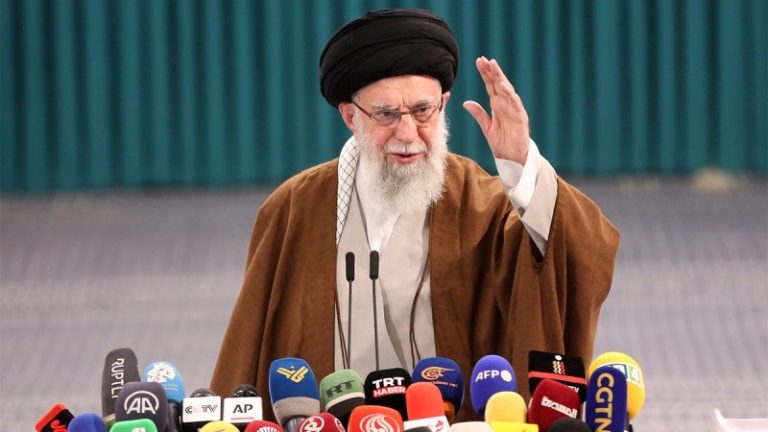
In the wake of the 12-day war between Israel and Iran, the regime appears to be turning inward — escalating repression with chilling speed. 

According to Kasra Aarabi, director of IRGC research at United Against Nuclear Iran, the Islamic Republic is accelerating toward what he said is a ‘North Korea-style model of isolation and control.’

‘We’re witnessing a kind of domestic isolation that will have major consequences for the Iranian people,’ Aarabi told Fox News Digital. ‘The regime has always been totalitarian, but the level of suppression now is unprecedented. It’s unlike anything we’ve seen before.’

A source inside Iran confirmed to Fox News Digital that ‘the repression has become terrifying.’

Aarabi, who maintains direct lines of contact in Iran, described a country under siege by its own rulers. In Tehran, he described how citizens are stopped at random, their phones confiscated and searched. ‘If you have content deemed pro-Israel or mocking the regime, you disappear,’ he said. ‘People are now leaving their phones at home or deleting everything before they step outside.’

This new wave of paranoia and fear, he explained, mirrors tactics seen in North Korea — where citizens vanish without explanation and information is tightly controlled. During the recent conflict, Iran’s leadership imposed a total internet blackout to isolate the population, blocking Israeli evacuation alerts, and pushed propaganda that framed Israel as targeting civilians indiscriminately.

‘It was a perverse objective,’ Aarabi said, adding, ‘They deliberately cut communications to instill fear and manipulate public perception. For four days, not a single message went through. Even Israeli evacuation alerts didn’t reach their targets.’

The regime’s aim, he said, was twofold: to keep people off the streets and erode the surprising bond that had formed between Iranians and Israelis. ‘At the start of the war, many Iranians welcomed the strikes,’ Aarabi noted. ‘They knew Israel was targeting the IRGC — the very forces responsible for suppressing and killing their own people. But once the internet was cut and fear set in, some began to question what was happening.’

Dr. Afshon Ostovar, a leading Iran scholar and author of ‘Vanguard of the Imam: Religion, Politics, and Iran’s Revolutionary Guards,’ said domestic repression remains the regime’s most reliable strategy for survival. 

‘Repressing the people at home is easy. That’s something they can do. So it’s not unlikely that Iran could become more insular, more autocratic, more repressive — and more similar to, let’s say, a North Korea — than what it is today. That might be the only way they see to preserve the regime: by really tightening the screws on the Iranian people, to ensure that the Iranian population doesn’t try to rise up and topple the regime,’ he told Fox News Digital.

Inside the regime’s power structure, the fallout from the war is just as severe. Aarabi said that the Islamic Revolutionary Guard Corps (IRGC) is facing an internal crisis of trust and an imminent purge. ‘These operations couldn’t have taken place without infiltration at the highest levels,’ he said. ‘There’s immense pressure now to clean house.’

The next generation of IRGC officers — those who joined after 2000 — are younger, more radical and deeply indoctrinated. Over half of their training is now ideological. Aarabi said that these newer factions have begun turning on senior commanders, accusing them of being too soft on Israel or even collaborating with Mossad.

‘In a twist of irony, Khamenei created these extreme ideological ranks to consolidate power — and now they’re more radical than he is,’ Aarabi said. ‘He’s struggling to control them.’

A purge is likely, along with the rise of younger, less experienced commanders with far higher risk tolerance — a shift that could make the IRGC more volatile both domestically and internationally. With Iran’s conventional military doctrine in ruins, terrorism may become its primary lever of influence.

‘The regime’s three pillars — militias, ballistic missiles, and its nuclear program — have all been decapitated or severely degraded,’ Aarabi said. ‘That leaves only asymmetric warfare: soft-target terrorism with plausible deniability.’

Despite the regime’s brutal turn inward, Aarabi insists this is a sign of weakness, not strength. ‘If the Islamic Republic were confident, it wouldn’t need to crush its people this way,’ he said. ‘It’s acting out of fear. But until the regime’s suppressive apparatus is dismantled, the streets will remain silent — and regime change remains unlikely.’

This post appeared first on FOX NEWS