Archive

July 2025

Browsing

For those who focus on sector rotation, whether to adjust portfolio weightings or invest directly in sector indexes, you’re probably wondering: Amid the current “risk-on” sentiment, even with ongoing economic and geopolitical uncertainties, can seasonality help you better anticipate shifts in sector performance?

Current Sector Performance Relative to SPY

To find out, let’s first look at how sectors are performing relative to the SPDR S&P 500 ETF (SPY), our S&P 500 proxy. The StockCharts Market Summary Mini Charts tab in the US Sectors panel shows you sector ETF performance and its relative performance against SPY.

FIGURE 1. MARKET SUMMARY US SECTORS PANEL. The new micro charts feature provides a chart of each sector’s ETF plus its relative performance against SPY, allowing you to gauge a sector’s strength against the broader market.

Looking at each sector chart over a three-month time frame, only two sectors are outperforming relative to SPY:

  1. Technology Select Sector SPDR Fund (XLK): Currently outperforming SPY by 13.85%.
  2. Industrial Select Sector SPDR Fund (XLI): Outpacing SPY by a modest 2.53%.

Spotlight on Technology and Industrials: Leading Sectors in a Risk-On Market

As a side note, Technology and Industrials are two sectors that align with the risk-on narrative. This suggests that the market is currently favoring higher-beta stocks (as XLK’s performance reflects) over safer sectors and that demand for industrial goods is generally rising, a sign investors expect the economy to strengthen.

Understanding Sector Seasonality: What History Tells Us

Now, let’s turn to seasonality. In this context, seasonality refers to the tendency for certain sectors to perform better during specific periods and worse during others. While past performance never guarantees future results, it can help you anticipate how a sector might behave based on historical tendencies, not certainties. 

So, what might the seasonality charts suggest about XLK and XLI in the coming months?.

XLK Seasonality Trends: Tech Sector’s Strongest Months

Take a look at XLK’s 10-year seasonality chart.

FIGURE 2. 10-YEAR SEASONALITY CHART OF XLK. While September appears to be tech’s only bearish month from a seasonality perspective, its strongest months are November and July. 

Over 10 years, July has been XLK’s second strongest month, with positive closes 90% of the time and an average monthly return of 4%. The most profitable month is November, with an 89% positive close rate and a 5% average monthly return. August isn’t bad, but July is exceptionally strong and reflects its current overall performance.

XLI Seasonality Patterns: When Industrials Tend to Outperform

Switching over to a seasonality chart of XLI, we get a similar picture.

FIGURE 3. 10-YEAR SEASONALITY CHART OF XLI. July is XLI’s strongest month for positive closes, and November is its strongest month for average seasonal returns.

This pattern is pretty exceptional: over the last 10 years, XLI has posted a historical 100% positive close rate in July, with an average return of 3.5%. The strongest returns, however, tend to occur in November, which shows an 89% positive close rate and an average return of 6.5%. The months in between are relatively unremarkable, making July and November stand out significantly. 

Technical Analysis of XLK and XLI

Will July be another up-month for XLK and XLI? Starting with XLK, let’s switch over to a six-month daily chart.

FIGURE 4. DAILY CHART OF XLK. Tech’s upward trajectory is now in overbought territory, yet there’s little sign of slowing.

XLK is at an all-time high, and there’s no clear indication that it’s pulling back just yet. 

Meanwhile, the Relative Strength Index (RSI) is suggesting that XLK has been occupying overbought territory since late June. However, bear in mind that an RSI reading at this level can sustain itself for an extended period. And if you look at the On Balance Volume (OBV) indicator, it suggests that the buying pressure trend is still rising with no signs of slowing down.

Actionable Tip: Remember, July is one of XLK’s historically strong seasonal months. 

  • But if it does pull back soon, you might expect a bounce near $242.50, which is an area marked by a series of historical swing highs. 
  • Notice how the ZigZag line highlights these key swing points. 
  • Other areas of support sit around $235, its most recent swing low, and $225, the level of its most recent swing low.

Now let’s turn to the daily chart of XLI.

FIGURE 5. DAILY CHART OF XLI. Industrials are also surging, although buying pressure may be starting to decline.

Similar to the previous chart, XLI shows a move higher that places it well into all-time high territory. July is also an exceptionally strong month for XLI, but does it have enough fuel to return the seasonal 3.5% that it typically averages this month?

The RSI signals that XLI may be overbought, which, again, can remain there for some time, while the OBV suggests that buying pressure may be easing into a pullback. However, price continues its upward trajectory.

Actionable Tip: If XLI dips, the pullback may be shallow, potentially bouncing near $145, its most recent swing high. A more substantial support level lies around $141, where multiple swing lows have formed. If XLI drops below $141, you can expect further downside movement.

At the Close

While no strategy can guarantee success, combining seasonality insights with price action can help improve your market timing. Keep an eye on support levels as well as momentum and volume. Remember that the strongest months for XLK and XLI tend to be July (the current month) and November. You can add XLK and XLI to your ChartLists and keep an eye on them, especially in the months ahead. 

However, the big takeaway here is to consider using seasonality charts alongside the various tools in the Market Summary, whether you’re considering an individual stock, index (sector or industry), or other asset classes, like commodities and monetary metals. While price action can help you nail down specific market opportunities, seasonality charts can help contextualize current price action and anticipate potential future market scenarios.


Disclaimer: This blog is for educational purposes only and should not be construed as financial advice. The ideas and strategies should never be used without first assessing your own personal and financial situation, or without consulting a financial professional.


  •   High-grade gold intercepts highlighted by 15.5 m at 2.30 g/t Au, incl. 8.3 m at 3.43 g/t Au at the Road Cut Zone  
  •  

  •   Initial drilling on the gap between Jagger and Road Cut Zone confirms target structure, warrants further testing  
  •  

  •   Current drill phase complete; Geological modelling and planning underway for 15,000 m drill program expected to begin in H2 2025  
  •  


 Kobo Resources Inc. (‘ Kobo’ or the ‘ Company ‘) ( TSX.V: KRI ) is pleased to report additional diamond drill results from the Road Cut Zone at its 100%-owned Kossou Gold Project (‘ Kossou ‘) in Côte d’Ivoire. Results from these holes continue to strengthen the Company’s understanding of the key structural controls that define this prospective target area.


This press release features multimedia. View the full release here: https://www.businesswire.com/news/home/20250710272213/en/  


Figure 1: Road Cut Zone Drill Hole Locations and Simplified Geology


The Company also completed an initial test of the gap between the Road Cut and Jagger Zones, confirming the presence of the interpreted structure. Additionally, the Company has provided an outline of its next exploration priorities as it advances plans for its next phase of drilling and regional target work.


  Diamond Drill Results – Highlights:  


  Road Cut Zone:  


  •   KDD0088  
    •   3.5 metres (‘m’) at 2.33 g/t Au from 81.0 m  
    •  

    •   1.0 m at 3.32 g/t Au from 119.0 m  
    •  

  •  

  •   KDD0090  
    •   9.75 m at 1.69 g/t Au from 67.25, including 5.10 m at 2.93 g/t Au, from 68.9 m and 1.0 m at 11.30 g/t Au from 68.9 m, and  
    •  

    •   11.0 m at 2.88 g/t Au from 140.0 m, including 3.0 m at 8.25 g/t Au from 143.0 m  
    •  

  •  

  •   KDD0091  
    •   5.0 m at 3.05 g/t Au from 28.0 m  
    •  

    •   15.5 m at 2.30 g/t Au from 123.0 m, including 8.0 m at 3.43 g/t Au from 126.0 m  
    •  

  •  

  •   KDD0092  
    •   6.0 m at 2.05 g/t Au from 88.0 m  
    •  

  •  

  •   KDD0093  
    •   6.0 m at 1.58 g/t Au from 76.0 m  
    •  

    •   7.95 m at 0.43 g/t Au from 106.0 m  
    •  

  •  

Edward Gosselin, CEO and Director of Kobo commented: ‘Our latest drilling has outlined additional strong gold mineralization at the Road Cut Zone, highlighting its scale and the consistency of grades and widths we are seeing along strike and down dip. Importantly, these results build on our understanding of the structural setting at Kossou and will help guide how we advance the Road Cut Zone in parallel with the Jagger Zone, including the structural corridor between the two targets.’  


He continued: ‘With this phase of diamond drilling now complete, our team is focused on advancing a larger, systematic program to further define the Jagger, Road Cut and Contact Zones, test the potential connection of the gap between these Jagger and Road Cut Zones, and expand our footprint to new targets identified at the Jagger South area and the underexplored western portion of the permit. Based on the work completed to date, we remain confident in the scale and continuity of mineralization at Kossou and believe the project continues to demonstrate significant potential as we move towards the next phase of drilling and a maiden Mineral Resource Estimate.’  


  Road Cut Zone Results  


Results from six diamond drill holes at the Road Cut Zone have been received. Holes KDD0088 to KDD0090 were drilled on three sections (RCZ725 to RCZ775) (see Figure 1) to test gold mineralization associated with diamond drill hole KDD0056 , which previously returned 10.0 m at 4.57 g/t Au ( see press release dated January 30, 2025 ).


  KDD0090 intersected two zones of strong gold mineralization: an upper intercept of 9.75 m at 1.69 g/t Au , including 1.0 m at 11.20 g/t Au , highlighting the high-grade nature of the cross-cutting V2 veins within the dominant northerly trending shear systems. The second intercept, 11.0 m at 2.88 g/t Au from 140.0 m, including 3.0 m at 8.25 g/t Au from 143.0 m, supports the continuity of high-grade mineralization within a previously identified structure (see Figure 2). Results from KDD0088 and KDD0089 , which returned 3.5 m at 2.33 g/t Au from 81.0 m, illustrate the variability of gold grades within the well-defined shear zones at the Road Cut Zone. These mineralised zones remain open at depth and will be targeted in future drilling.


A second set of holes, KDD0091 to KDD0093 (see Figure 3), targeted an area of artisanal mining previously trenched and sampled by the Company, which returned strong gold mineralization including trench KTR070 with 28.0 m at 4.44 g/t Au and trench KTR069 with 6.0 m at 2.50 g/t Au ( see press release dated December 5, 2023 ). Previous diamond drilling on this target also confirmed strong mineralization, including hole KDD0012 , which intersected 11.0 m at 1.71 g/t Au from 50.0 m ( see press release dated July 11, 2024 ).


All drill holes intersected significant gold mineralization, highlighted by KDD0091 , which returned 15.55 m at 2.30 g/t Au from 123.0 m, including 8.30 m at 3.43 g/t Au from 126.0 m. The mineralized zone is characterized by strong shearing within the basaltic host rocks, cross-cut by a series of V2 and V1 veins that are strongly altered and host gold mineralization that was consistent throughout the interval. This zones shows excellent continuity from surface down dip on the section RCZ500 (see Figure 4). Additional drilling is being planned to test these structures to the north and south along strike of shear zone and to depth.


  Testing Structural Corridor Between Jagger and Road Cut Zones  


One hole, KDD0087 , was drilled within the interpreted structural corridor between the Road Cut and Jagger Zones. The hole intersected a well-defined shear zone near surface but did not return significant gold mineralization. The presence of the shear structure provides further support for Kobo’s geological interpretation in this area. Additional drilling is planned to continue assessing the potential structural linkages and mineralization continuity between these two high-priority targets.


  Soil Geochemistry to Define Targets: South Jagger and Western Kossou Permit Area  


The Company has extended detailed infill soil geochemistry across the South Jagger Zone, collecting 270 samples to date. Previous infill sampling on a 25 m by 25 m grid proved effective in defining drill-ready targets at the Road Cut, Jagger and Kadie Zones further north. The South Jagger soil anomaly, which consistently returned values up to 1000+ ppb Au, now extends over a distance greater than 2 km, reinforcing its potential for follow-up drilling.


In addition, recent soil geochemical surveying has outlined a new northwest-trending anomaly of over 400 m in the western portion of the Kossou Permit, with individual sample results returning values up to 1,380 ppb gold. These results further support systematic target definition and demonstrate the upside potential across less-explored portions of the permit.


  Update on Regional Exploration: Kotobi Permit  


At the Kotobi Permit, the Company has collected 1,942 soil samples to date, with additional results pending. Recent work has defined a 50+ ppb gold-in-soil anomaly extending over 400+ m of strike length, with individual samples returning between 370 ppb and 1,420 ppb Au. Follow-up pitting and trenching are currently underway to better define this anomaly and assess its potential for future exploration work.


  Earn-In Agreement: NESDAVE MINING  


Regional scale soil geochemical sampling is underway at the Akoboissue Permit (PR0970). Information meetings are underway with local village chiefs and elders with respect to the Annépé Permit (PR0973) and regional scale soil geochemical sampling is expected begin shortly.


  Next Steps: Preparing for Expanded Drilling and maiden Mineral Resource Estimate at Kossou  


With this current phase of drilling now complete, the Company’s exploration and technical team is integrating the latest drill data into detailed geological models to refine its understanding of the structural controls at the Jagger and Road Cut Zones. This work will directly inform the Company’s next major drill campaign, which is anticipated to comprise more than 15,000 m of additional diamond drilling and begin in H2 2025. This expanded program will prioritize systematic step-out and deeper drilling at the Jagger Zone to support preliminary resource modelling, continue expansion drilling at the Road Cut Zone, and follow up on the interpreted structural corridor between the two zones.


Further, the Company plans to advance the Contact Zone with targeted drilling based on structural mapping completed to date and begin testing new targets on the western side of the Kossou Permit, supported by recent soil geochemical results indicating a strong northwest-trending gold anomaly. This methodical approach is designed to build on the Company’s drilling success to date, advance the potential for a future maiden Mineral Resource Estimate, and support the Company’s broader strategy to unlock value within Côte d’Ivoire’s highly prospective Birimian gold belt.


  Table 1: Summary of Significant Diamond Drill Hole Results  


  BHID  


  East  


  North  


  Elev.  


  Az.  


  Dip  


  Length  


  From (m)  


  To
(m)


  Int.
(m)


  Au
g/t


  Target  


KDD0087


228681


775702


278


70


-50


113.00


NSR


Jagger


KDD0088


228495


775956


289


70


-50


173.00


55.00


57.00


2.00


0.88


RCZ


  81.00  


  84.50  


  3.50  


  2.33  


  RCZ  


  119.00  


  120.00  


  1.00  


  3.32  


  RCZ  


143.00


144.00


1.00


1.61


RCZ


KDD0089


228487


775979


283


70


-50


179.00


59.00


62.00


3.00


0.56


RCZ


KDD0090


228500


775931


294


70


-50


182.00


  67.25  


  77.00  


  9.75  


  1.69  


  RCZ  


incl.


  68.90  


  74.00  


  5.10  


  2.93  


  RCZ  


incl.


  68.90  


  70.00  


  1.00  


  11.20  


  RCZ  


104.00


105.00


1.00


1.67


RCZ


  140.00  


  151.00  


  11.00  


  2.88  


  RCZ  


incl.


  140.00  


  146.00  


  6.00  


  4.66  


  RCZ  


incl.


  143.00  


  146.00  


  3.00  


  8.25  


  RCZ  


KDD0091


228480


776270


244


70


-50


161.00


  28.00  


  33.00  


  5.00  


  3.05  


  RCZ  


  123.00  


  138.55  


  15.55  


  2.30  


  RCZ  


incl.


  126.00  


  138.55  


  12.55  


  2.77  


  RCZ  


incl.


  126.00  


  134.30  


  8.30  


  3.43  


  RCZ  


KDD0092


228529


776261


226


70


-50


116.00


  88.00  


  94.00  


  6.00  


  2.05  


  RCZ  


104.00


106.00


2.00


0.67


RCZ


112.00


115.00


3.00


0.76


RCZ


KDD0093


228510


776307


225


70


-50


116.00


  76.00  


  82.00  


  6.00  


  1.58  


  RCZ  


106.05


114.00


7.95


0.43


RCZ


  Notes:  


Cut-off using 2.0 m at 0.30 g/t Au


Intervals are reported with no more than 3 m of internal dilution of less than 0.3 g/t Au except where indicated*


An accurate dip and strike and controls of mineralisation are unconfirmed and mineralised zones are reported as downhole lengths. Drill holes are planned to intersect mineralised zones perpendicular to interpreted targets. All intercepts reported are downhole distances.


  Sampling, QA/QC, and Analytical Procedures  


Drill core was logged and sampled by Kobo personnel at site. Drill cores were sawn in half, with one half remaining in the core box and the other half secured into new plastic sample bags with sample number tickets. Core samples are drilled using HQ core barrels to below the level of oxidation and then reduced to NQ core barrels for the remainder of the bore hole. Samples are transported to the SGS Côte d’Ivoire facility in Yamoussoukro by Kobo personnel where the entire sample was prepared for analysis (prep code PRP86/PRP94). Sample splits of 50 grams were then analysed for gold using 50g Fire Assay as per SGS Geochem Method FAA505. QA/QC procedures for the drill program include insertion of a certificated standards every 20 samples, a blank every 20 samples and a duplicate sample every 20 samples. All QAQC control samples returned values within acceptable limits.


  Review of Technical Information  


The scientific and technical information in this press release has been reviewed and approved by Paul Sarjeant, P.Geo., who is a Qualified Persons as defined in National Instrument 43-101. Mr. Sarjeant is the President and Chief Operating Officer and Director of Kobo.


  About Kobo Resources Inc.  


 Kobo Resources is a growth-focused gold exploration company with a compelling new gold discovery in Côte d’Ivoire, one of West Africa’s most prolific and developing gold districts, hosting several multi-million-ounce gold mines. The Company’s 100%-owned Kossou Gold Project is located approximately 20 km northwest of the capital city of Yamoussoukro and is directly adjacent to one of the region’s largest gold mines with established processing facilities.


With over 18,500 metres of diamond drilling, nearly 5,900 metres of reverse circulation (RC) drilling, and 5,900 metres of trenching completed since 2023, Kobo has made significant progress in defining the scale and prospectivity of its Kossou’s Gold Project. Exploration has focused on multiple high-priority targets within a 9+ km strike length of highly prospective gold-in-soil geochemical anomalies, with drilling confirming extensive mineralisation at the Jagger, Road Cut, and Kadie Zones. The latest phase of drilling has further refined structural controls on gold mineralisation, setting the stage for the next phase of systematic exploration and resource development.


Beyond Kossou, the Company is advancing exploration at its Kotobi Permit and is actively expanding its land position in Côte d’Ivoire with prospective ground, aligning with its strategic vision for long-term growth in-country. Kobo remains committed to identifying and developing new opportunities to enhance its exploration portfolio within highly prospective gold regions of West Africa. Kobo offers investors the exciting combination of high-quality gold prospects led by an experienced leadership team with in-country experience. Kobo’s common shares trade on the TSX Venture Exchange under the symbol ‘KRI’. For more information, please visit www.koboresources.com .


NEITHER THE TSXV NOR ITS REGULATION SERVICES PROVIDER (AS THAT TERM IS DEFINED IN THE POLICIES OF THE TSXV) ACCEPTS RESPONSIBILITY FOR THE ADEQUACY OR ACCURACY OF THIS RELEASE.


   Cautionary Statement on Forward-looking Information:   


  This news release contains ‘forward-looking information’ and ‘forward-looking statements’ (collectively, ‘forward-looking statements’) within the meaning of the applicable Canadian securities legislation. All statements, other than statements of historical fact, are forward-looking statements and are based on expectations, estimates and projections as at the date of this news release. Any statement that involves discussions with respect to predictions, expectations, beliefs, plans, projections, objectives, assumptions, future events or performance (often but not always using phrases such as ‘expects’, or ‘does not expect’, ‘is expected’, ‘anticipates’ or ‘does not anticipate’, ‘plans’, ‘budget’, ‘scheduled’, ‘forecasts’, ‘estimates’, ‘believes’ or ‘intends’ or variations of such words and phrases or stating that certain actions, events or results ‘may’ or ‘could’, ‘would’, ‘might’ or ‘will’ be taken to occur or be achieved) are not statements of historical fact and may be forward-looking statements Forward-looking statements are necessarily based upon a number of estimates and assumptions that, while considered reasonable, are subject to known and unknown risks, uncertainties, and other factors which may cause the actual results and future events to differ materially from those expressed or implied by such forward-looking statements. Such factors include, but are not limited to: general business, economic, competitive, political and social uncertainties; and the delay or failure to receive board, shareholder or regulatory approvals. There can be no assurance that such statements will prove to be accurate, as actual results and future events could differ materially from those anticipated in such statements. Accordingly, readers should not place undue reliance on the forward-looking statements and information contained in this news release. Except as required by law, Kobo assumes no obligation and/or liability to update the forward-looking statements of beliefs, opinions, projections, or other factors, should they change, except as required by law.  


  View source version on businesswire.com:    https://www.businesswire.com/news/home/20250710272213/en/   


For further information, please contact:


Edward Gosselin
Chief Executive Officer and Director
1-418-609-3587
ir@kobores.com  


Twitter: @KoboResources | LinkedIn: Kobo Resources Inc. 

 

News Provided by Business Wire via QuoteMedia

This post appeared first on investingnews.com

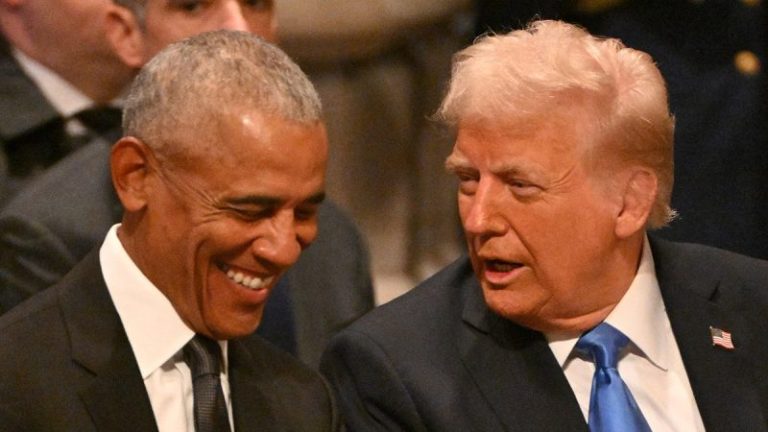
President Donald Trump and former President Barack Obama chatted about golf during a viral moment of bipartisanship during former President Jimmy Carter’s funeral in January, just days before Trump’s return to the Oval Office, a new book detailing the unprecedented 2024 election cycle reported. 

Trump and Obama were seen smiling and quietly chatting with one another in the pews of the Washington National Cathedral on Jan. 9, 2025, in a moment that spread like wildfire on social media as Americans sounded off with speculation over what the pair of presidents who had long traded political barbs were talking about. 

‘2024: How Trump Retook the White House and the Democrats Lost America,’ which was released Tuesday, said that Trump arrived in Washington for Carter’s funeral as a ‘conqueror’ following the November 2024 election and sat next to Obama for the funeral service. 

‘He’d attended Jimmy Carter’s funeral, walking into Washington not as a scourge but as a conqueror,’ the book reported of Trump. ‘He could ignore the speech on character by the outgoing president, and the cold shoulder from the vice president he’d defeated.’

‘Instead he sat next to Barack Obama and invited him to play golf, enticing him with descriptions of Trump’s courses around the world,’ the book continued of the pair’s conversation. ‘He was no longer an anomaly. He was being treated like an American president. He wanted to be remembered as a great one.’

Trump and Obama were seated near other high-profile former U.S. leaders, including former President George W. Bush, former Vice President Mike Pence, former President Bill Clinton, former first lady and Secretary of State Hillary Clinton, as well as then-President Joe Biden and then-Vice President Kamala Harris.

Social media commenters at the time remarked that footage and video clips of the pair were unexpected, and others joked that Obama may have voted for Trump despite years of the pair trading political barbs. 

‘Trump and Obama sitting next to each other was not on the 2025 bingo card,’ one social media user posted to X in January. 

‘Did Obama vote for Trump too?!’ Clay Travis, founder of sports and politics commentary platform OutKick, joked at the time. 

‘We need lip readers to see what Trump said to make Obama laugh,’ another person posted to X in January. 

Trump was asked about the viral moment ahead of his inauguration, remarking that he ‘didn’t realize how friendly it looked.’

‘I said, ‘Boy, they look like two people that like each other.’ And we probably do,’ Trump added at the time. ‘We have a little different philosophies, right? But we probably do. I don’t know. We just got along. But I got along with just about everybody.’

Fox News Digital’s Kristine Parks contributed to this report. 

This post appeared first on FOX NEWS

Amazon is extending its annual Prime Day sales and offering new membership perks to Gen Z shoppers amid tariff-related price worries and possibly some consumer boredom with an event marking its 11th year.

For the first time, Seattle-based Amazon is holding the now-misnamed Prime Day over four days. The e-commerce giant’s promised blitz of summer deals for Prime members started at 3:01 a.m. Eastern time on Tuesday and ends early Friday.

Amazon launched Prime Day in 2015 and expanded it to two days in 2019. The company said this year’s longer version would have deals dropping as often as every 5 minutes during certain periods.

Prime members ages 18-24, who pay $7.49 per month instead of the $14.99 that older customers not eligible for discounted rates pay for free shipping and other benefits, will receive 5% cash back on their purchases for a limited time.

Amazon executives declined to comment on the potential impact of tariffs on Prime Day deals. The event is taking place two and a half months after an online news report sparked speculation that Amazon planned to display added tariff costs next to product prices on its website.

White House Press Secretary Karoline Leavitt denounced the purported change as a “hostile and political act” before Amazon clarified the idea had been floated for its low-cost Haul storefront but never approved.

Amazon’s past success with using Prime Day to drive sales and attract new members spurred other major retail chains to schedule competing sales in July. Best Buy, Target and Walmart are repeating the practice this year.

Like Amazon, Walmart is adding two more days to its promotional period, which starts Tuesday and runs through July 13. The nation’s largest retailer is making its summer deals available in stores as well as online for the first time.

Here’s what to expect:

Amazon expanded Prime Day this year because shoppers “wanted more time to shop and save,” Amazon Prime Vice President Jamil Ghani recently told The Associated Press.

Analysts are unsure the extra days will translate into more purchases given that renewed inflation worries and potential price increases from tariffs may make consumers less willing to spend. Amazon doesn’t disclose Prime Day sales figures but said last year that the event achieved record global sales.

Adobe Digital Insights predicts that the sales event will drive $23.8 billion in overall online spending from July 8 to July 11, 28.4% more than the similar period last year. In 2024 and 2023, online sales increased 11% and 6.1% during the comparable four days of July.

Vivek Pandya, lead analyst at Adobe Digital Insights, noted that Amazon’s move to stretch the sales event to four days is a big opportunity to “really amplify and accelerate the spending velocity.”

Caila Schwartz, director of consumer insights and strategy at software company Salesforce, noted that July sales in general have lost some momentum in recent years. Amazon is not a Salesforce Commerce Cloud customer, so the business software company doesn’t have access to the online giant’s e-commerce sales and so is not privy to Prime Day figures.

“What we saw last year was that (shoppers) bought and then they were done, ” Schwartz said. “We know that the consumer is still really cautious. So it’s likely we could see a similar pattern where they come out early, they’re ready to buy and then they take a step back.”

Amazon executives reported in May that the company and many of its third-party sellers tried to beat big import tax bills by stocking up on foreign goods before President Donald Trump’s tariffs took effect. And because of that move, a fair number of third-party sellers hadn’t changed their pricing at that time, Amazon said.

Adobe Digital Insights’ Pandya expects discounts to remain on par with last year and for other U.S. retail companies to mark 10% to 24% off the manufacturers’ suggested retail price between Tuesday and Friday.

Salesforce’s Schwartz said she’s noticed retailers becoming more precise with their discounts, such as offering promotion codes that apply to selected products instead of their entire websites.

Amazon Prime and other July sales have historically helped jump-start back-to-school spending and encouraged advance planners to buy other seasonal merchandise earlier. Analysts said they expected U.S. consumers to make purchases this week out of fear that tariffs will make items more expensive later.

Brett Rose, CEO of United National Consumer Supplies, a wholesale distributor of overstocked goods like toys and beauty products, thinks shoppers will go for items like beauty essentials.

“They’re going to buy more everyday items,” he said.

As in past years, Amazon offered early deals leading up to Prime Day. For the big event, Amazon said it would have special discounts on Alexa-enabled products like Echo, Fire TV and Fire tablets.

Walmart said its July sale would include a 32-inch Samsung smart monitor priced at $199 instead of $299.99; and $50 off a 50-Inch Vizio Smart TV with a standard retail price of $298.00. Target said it was maintaining its 2024 prices on key back-to-school items, including a $5 backpack and a selection of 20 school supplies totaling less than $20.

Independent businesses that sell goods through Amazon account for more than 60% of the company’s retail sales. Some third-party sellers are expected to sit out Prime Day and not offer discounts to preserve their profit margins during the ongoing tariff uncertainty, analysts said.

Rose, of United National Consumer Supplies, said he spoke with third-party sellers who said they would rather take a sales hit this week than use up a lot of their pre-tariffs inventory now and risk seeing their profit margins suffer later.

However, some independent businesses that market their products on Amazon are looking to Prime Day to make a dent in the inventory they built up earlier in the year to avoid tariffs.

Home fragrance company Outdoor Fellow, which makes about 30% of its sales through Amazon’s marketplace, gets most of its candle lids, labels, jars, reed diffusers and other items from China, founder Patrick Jones said. Fearing high costs from tariffs, Jones stocked up at the beginning of the year, roughly doubling his inventory.

For Prime Day, he plans to offer bigger discounts, such as 32% off the price of a candle normally priced at $34, Jones said.

“All the product that we have on Amazon right now is still from the inventory that we got before the tariffs went into effect,” he said. “So we’re still able to offer the discount that we’re planning on doing.”

Jones said he was waiting to find out if the order he placed in June will incur large customs duties when the goods arrive from China in a few weeks.

This post appeared first on NBC NEWS

Just when we thought tariff talk had gone quiet, it’s back on center stage. With the reciprocal tariff deadline landing this Wednesday, President Trump has mailed out notices that new duties will kick in on August 1. Countries such as Japan, South Korea, Malaysia, and Kazakhstan face a 25% levy, while a few others may see steeper rates.  

Wall Street didn’t take the news well. On Monday, the S&P 500 ($SPX) closed lower by 0.79%.  

Before the July 4 long weekend, the S&P 500 and Nasdaq Composite ($COMPQ) notched fresh record highs, buoyed by solid jobs data. But like migratory birds, tariffs circled back on Monday and pushed stocks lower almost across the board.  

Monday’s performance can be encapsulated by the StockCharts MarketCarpets screenshot below. It was pretty much red except for a few lonely green squares. 

FIGURE 1. STOCK MARKET’S PERFORMANCE ON MONDAY, JULY 7. Besides a few lonely green squares, the screen lit up red. Image source: StockCharts.com. For educational purposes.

Why Pullbacks Can Be Your Friend

Stock market pullbacks aren’t all bad. They give investors and traders a chance to go bargain hunting. A handy tool is the Market Movers panel in your StockCharts Dashboard. Check the “S&P 500 % Down” category to spot the 10 stocks in the index that had the largest % loss for the trading day. Then view the charts and see if any deserve a place in your ChartLists.

Two names that caught my eye: 

  1. Tesla, Inc. (TSLA)
  2. ON Semiconductor Corp. (ON) 

FIGURE 2. MARKET MOVERS PANEL FROM MONDAY, JULY 7. From this list, two stocks worth considering as “buy the dip” opportunities are TSLA and ON. Image source: StockCharts.com. For educational purposes.

Tesla, Inc. (TSLA): Sitting on the Fence

While it’s clear that politics helped knock TSLA down, the chart tells a fuller story. 

From the daily chart of TSLA below, it’s clear that the stock has seen some erratic movement recently. 

FIGURE 3. DAILY CHART OF TSLA’S STOCK PRICE. TSLA’s stock price has danced above and below its 200-day simple moving average, and momentum is relatively weak. Chart source: StockCharts.com. For educational purposes.

Since April, TSLA’s stock price looked like it was recovering after it broke out above its 200-day simple moving average (SMA). However, in early June it dipped below it and then went above it, and is now back below it. The June 23 high was below the end of May high. The relative strength index (RSI) and percentage price oscillator (PPO) indicate weakening momentum. The big question is where is TSLA going to find support? 

Watch three support levels on your chart. TSLA’s stock price has moved above the first support level. Look for momentum to pick up to confirm the upside move. If TSLA’s stock price doesn’t hold at this level and falls further towards the $270 or $220 levels, similar conditions would apply. However, a significant fall in price would weaken momentum significantly and would need stronger evidence to consider going long. 

ON Semiconductor (ON): Stalling at Resistance

ON has lagged its chip-making peers. Over the past year, ON Semiconductor has underperformed the VanEck Semiconductor ETF (SMH). ON supplies chips to automakers and manufacturers, so its fortunes rise and fall with car demand. 

The daily chart of ON below shows that since early April the stock price has recovered with a series of higher highs and higher lows. It is now facing resistance of its 200-day SMA, a resistance area that coincides with the February high and the early January gap down. Momentum looks like it’s rising as indicated by the slight rise in RSI and a potential bullish crossover in the PPO. 

FIGURE 4. DAILY CHART OF ON SEMICONDUCTOR. Since early April, ON has printed higher highs and higher lows. The stock price is now hovering around its 200-day SMA, and momentum seems to be gaining a little strength. Chart source: StockCharts.com. For educational purposes.

I would look for ON to clear $58 on strong volume and improving momentum before opening a long position.  

Closing Position

  • Add price alerts in StockCharts at each support level (for TSLA) or resistance level (for ON).
  • When an alert triggers, re-evaluate the chart to confirm if momentum is strong enough for a price reversal and upside follow-through. 

A short-term investment could be a better choice for TSLA since its price performance is correlated to Elon Musk’s involvement with the company. 

ON could be a steadier, longer-term investment if the stock price breaks above resistance. 

No matter what, decide in advance where you’ll place your stops. Then stick to your plan because discipline always wins.


Disclaimer: This blog is for educational purposes only and should not be construed as financial advice. The ideas and strategies should never be used without first assessing your own personal and financial situation, or without consulting a financial professional.

The Trump administration landed a legal victory on Monday after a federal judge allowed the Department of Justice (DOJ) to rescind nearly $800 million dollars in grants for programs supporting violence reduction and crime victims.

U.S. District Judge Amit Mehta in Washington denied a preliminary injunction that five organizations sought against the DOJ’s cancellation of more than 360 grant awards and granted a motion to dismiss the case. 

Metha described the DOJ’s actions as ‘shameful’ in his ruling, though he ultimately declared that the court lacked jurisdiction and the organizations had failed to state a constitutional violation or protection.

‘Defendants’ rescinding of these awards is shameful. It is likely to harm communities and individuals vulnerable to crime and violence,’ Mehta wrote. ‘But displeasure and sympathy are not enough in a court of law.’

The DOJ’s Office of Justice Programs canceled more than $800 million in grants in April as part of what it called a priority shift to include more direct support to certain law enforcement operations, combat violent crime and support American victims of trafficking and sexual assault.

Democracy Forward Foundation and the Perry Law firm filed the lawsuit, arguing the grant terminations did not allow due process, lacked sufficient clarity and violated the constitutional separation of powers clause that gives Congress appropriation powers.

The loss of the federal money triggered layoffs, program closures and loss of community partnerships, according to many of the organizations that had the grants rescinded.

The Justice Department argued in a court filing that there was ‘no legal basis for the Court to order DOJ to restore lawfully terminated grants and keep paying for programs that the Executive Branch views as inconsistent with the interests of the United States.’

Noting that it intended to redirect the grant funds, it called the suit a ‘run-of-the mill contract dispute’ and said it belonged in a different court.

The Associated Press contributed to this report.

This post appeared first on FOX NEWS

Boeing delivered 60 airplanes last month, the most since December 2023, as the plane maker seeks to raise production of its bestselling 737 Max jets after a series of manufacturing and safety problems.

The tally was the highest since before a door plug from one of its new 737 Max 9 planes blew out midair in January 2024, sparking a new crisis for the company and slowing production and deliveries of aircraft. Of the monthly total, 42 were 737 Maxes, going to customers including Southwest Airlines, Alaska Airlines and United Airlines.

CEO Kelly Ortberg, who took the top job at Boeing last August, has said the company has made progress in improving production rates and quality on its factory lines.

For the three months ended June 30, Boeing handed over 150 airplanes, its best second quarter since 2018, before two crashes of Max planes five months apart grounded the jets and sparked a multiyear crisis at the top U.S. exporter. That was also the last year Boeing posted an annual profit. Its problems also gave rival Airbus a bigger lead over Boeing.

Boeing this spring had been producing about 38 Max aircraft a month and will need Federal Aviation Administration approval to go above that limit, which the agency set after the door plug accident. Ortberg said at a Bernstein investor conference in late May that he’s confident that the company could increase production to 42 of the jets a month.

The company booked 116 gross orders in June, or 70 net orders when including cancellations and accounting adjustments. Boeing often removes or adds orders to its backlog for a variety of reasons including customers’ financial health.

Boeing’s backlog stood at 5,953 as of June 30.

The manufacturer is set to report second-quarter financial results on July 29, when investors will be focused on Ortberg’s plan to increase production and aircraft deliveries.

This post appeared first on NBC NEWS

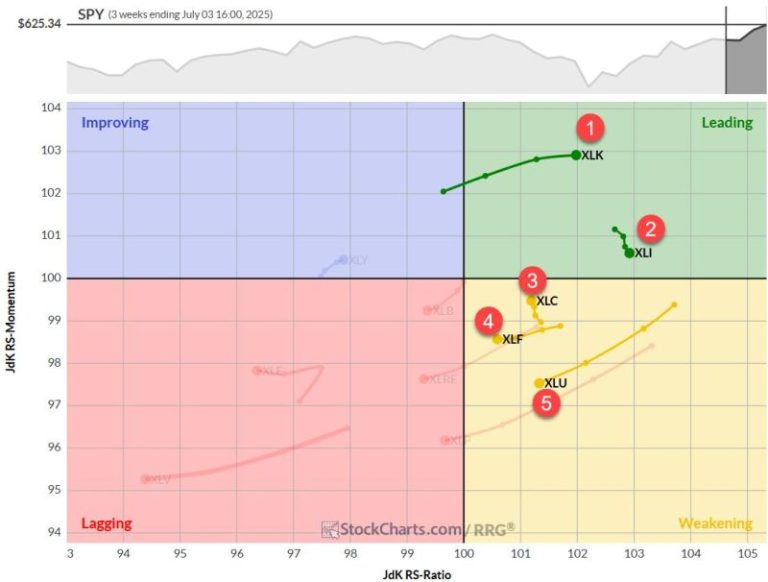
The past week has been relatively stable in terms of sector rankings, with no new entrants or exits from the top five. However, we’re seeing some interesting shifts within the rankings that warrant closer examination. Let’s dive into the details and see what the Relative Rotation Graphs (RRGs) are telling us about the current market dynamics.

Sector Rankings Shuffle

The top three sectors, technology, industrials, and communication services, remain firmly entrenched in their positions. But the real action is happening just below them. Financials climbed to the number four spot, consequently pushing utilities down to fifth place. This shift is significant, as it indicates a move towards more cyclical sectors in the top rankings.

These changes suggest a potential shift towards more economically sensitive and offensive sectors, which supports a bullish scenario or at least a move away from defensive positioning.

  1. (1) Technology – (XLK)
  2. (2) Industrials – (XLI)
  3. (3) Communication Services – (XLC)
  4. (5) Financials – (XLF)*
  5. (4) Utilities – (XLU)*
  6. (8) Materials – (XLB)*
  7. (7) Consumer Staples – (XLP)
  8. (6) Real-Estate – (XLRE)*
  9. (10) Consumer Discretionary – (XLY)*
  10. (9) Energy – (XLE)*
  11. (11) Healthcare – (XLV)

Weekly RRG

The weekly Relative Rotation Graph continues to show strength in the technology sector within the leading quadrant. Industrials is also maintaining its position in the leading quadrant, with a very short tail, indicating a consistent relative uptrend.

Communication services, financials, and utilities are currently in the weakening quadrant. However, communication services have rebounded and appear to be making their way back towards the leading quadrant again.

Financials and utilities, on the other hand, are showing negative headings, with utilities displaying the weakest momentum (longest tail).

Daily RRG

Switching to the daily RRG, we get a more granular view of recent sector movements:

  • Technology remains the strongest sector, with a high RS ratio and a short tail
  • Communication services are rotating at a slightly negative heading but still within the leading quadrant
  • Financials and industrials are showing promise in the improving quadrant
  • Utilities continues to rotate within the lagging quadrant, confirming its weakness

The positioning of these sectors, particularly the strength of technology and improvements in financials and industrials, suggests a shift towards more cyclical and less defensive sectors in the market.

Technology

Tech continues its rally after breaking above the $240 resistance area. The raw RS line is also climbing, having broken out of its falling channel. This sector remains the market leader and shows no signs of slowing down.

Industrials

The industrial sector has cleared its overhead resistance and is pushing higher. Its RS line is putting in new highs, reflecting strong relative performance. The RRG lines remain in the leading quadrant and may be turning up again, a bullish sign.

Communication Services

Comms have broken above their resistance around 105. While still at the lower boundary of its rising RS channel, it’s starting to pick up steam. Both RRG lines are climbing, with RS momentum approaching the 100 level. A cross above that level would put it back in the leading quadrant.

Financials

Financials broke through overhead resistance last week, which is a significant positive development. It’s now above both horizontal resistance and its former support line. The relative strength line needs some work, but with the current price breakout, improvement seems likely in the near future.

Utilities

The weak link in the top five, utilities, remains range-bound. It’s still above support, but not by much. With the broader market rising, utilities’ sideways movement is causing its RS line to drop. The RRG lines are rolling over, and we may soon see this sector rotate into the lagging quadrant on the weekly RRG.

Portfolio Performance Update

I must admit, our portfolio is still underperforming. The current drawdown is a little over 8%, which isn’t ideal. However, this is the nature of trend-following strategies. We’re sticking with our approach through this period of underperformance, confident that historical results support our patience.

If market trends continue as they are, we should see more offensive sectors rotate into the top five. This shift, in turn, should help us overcome the current drawdown and eventually bring us ahead of the S&P again.

Remember, investing is a marathon, not a sprint. Periods of underperformance are normal and to be expected. The key is to stay disciplined and trust in your strategy.

#StayAlert and have a great week. –Julius


US President Donald Trump’s massive One Big Beautiful Bill is poised to reshape America’s entire industrial and energy future, dramatically reorienting policies and incentives for various industries.

Passed by the Senate by a 51 to 50 margin, with Vice President JD Vance breaking the tie, the legislation now heads to conference negotiations that will finalize its far-reaching impacts on energy investment, critical minerals and the digital economy.

Framed by the White House as a blueprint for restoring American industrial strength, the bill combines major fossil fuel incentives, nuclear supports, and deep tax cuts with steep rollbacks of renewable energy subsidies and critical minerals credits.

Here are some of the bill’s most significant provisions.

Mining incentives on the chopping block

Perhaps the most consequential piece of the “One Big Beautiful Bill” for the mining industry is its planned phaseout of the Section 45X advanced manufacturing production credit.

This 10 percent tax incentive was created under the 2022 Inflation Reduction Act to encourage domestic extraction, processing and recycling of critical minerals — such as lithium, nickel, cobalt and rare earth elements — that power batteries and other industrial technologies.

Under the new bill, the 45X credit would begin to wind down in 2031 and be eliminated entirely by 2034.

That reversal has drawn fierce criticism from mining advocates, who warn that scaling back the credit undermines efforts to build a resilient domestic supply chain.

Meanwhile, the National Mining Association, which has long called for expanded mining incentives, expressed their support for the bill’s passage and praised other funding provisions in the bill that support the industry.

“We urge the House to quickly pass this bill,” said Rich Nolan, National Mining Association president and CEO, in a statement after the Senate vote. “It increases the competitiveness of the American mining industry and provides vital incentives, including funding to counter China’s mineral dominance.”

The overall direction of the bill, though, makes clear that domestic producers will face a more challenging environment after a brief window of continued support up until 2034.

The bill’s tougher guardrails on critical mineral sourcing add to this challenge. Alongside the phaseout of 45X, lawmakers included new restrictions to curb reliance on “prohibited foreign entities” — primarily adversarial nations like China and Russia — in the supply chain.

Under the legislation, companies seeking the advanced manufacturing credit will have to pass a ‘material assistance cost ratio test’ to prove they are not overly dependent on inputs or components from these foreign entities.

Fossil fuels win big

The legislation delivers a sweeping victory to oil, gas and coal interests.

First, it mandates an ambitious leasing program for fossil fuel production, opening 30 lease sales in the Gulf of Mexico over 15 years and more than 30 lease sales annually on federal lands across nine states. It also cuts the royalties oil and gas producers pay to the government, aiming to encourage higher output.

“This bill will be the most transformational legislation that we’ve seen in decades in terms of access to both federal lands and federal waters,” Mike Sommers, president of the American Petroleum Institute, told CNBC.

“It includes almost all of our priorities.”

Coal producers, too, receive a major boost. The bill designates at least 4 million additional acres of federal land for coal mining and slashes the royalties paid by coal companies.

In a further sweetener for metallurgical coal producers, the bill permits them to use advanced manufacturing tax credits to support coal used in steelmaking.

In a controversial move, the bill also extends a carbon capture tax credit designed to trap carbon emissions from industrial facilities. However, under the new language, oil companies can claim a higher tax benefit for using captured CO2 to push more oil out of aging wells.

Hydrogen fuel investments get a partial reprieve: the hydrogen production tax credit will now end in 2028 instead of immediately, giving oil majors more time to roll out projects.

Renewables face deep cuts

In stark contrast to fossil fuels, renewable energy incentives are headed for a steep rollback. The legislation phases out the investment and production tax credits that have supported wind and solar since the 1990s.

Under the new plan, renewable power projects placed into service after 2027 will no longer qualify for these credits, although a one year grace period will apply to projects that begin construction within 12 months of the bill becoming law.

A related tax credit encouraging the use of US-made components in renewable installations will also expire for projects entering service after 2027. Projects that start construction in the year after the bill becomes law can still qualify, but anything beyond that window loses access to the incentive.

The bill also adopts Senate language providing a more gradual phaseout for these credits, rather than the abrupt cutoff proposed by the House.

Still, the overall impact is clear: after decades of public policy designed to grow wind and solar, their incentives are being dismantled.

President Trump’s views on renewables are no secret. In a June 29 Fox News interview, he criticized solar farms and wind turbines as “ugly as hell” and vowed to restore fossil fuels to the heart of US energy policy.

Crypto gets an indirect boost

Cryptocurrency investors have found reason for optimism in the bill, even though no direct amendments on crypto taxes made it into the final text.

As the bill moves forward, it extends the 2017 Trump-era tax cuts, adds new tax-free treatment for up to US$25,000 in tips and US$12,500 in overtime pay, and expands estate tax exemptions.

These changes are projected to raise the US national debt by between US$3.3 trillion and US$5 trillion over the next decade. That debt expansion, paired with more disposable income from tax cuts, has created a bullish narrative for Bitcoin and other cryptocurrencies as a hedge against inflation.

“More debt can lead to more money printing. That’s good for BTC in the long run,” crypto analyst Ranjay Singh said in an X post.

Crypto market observers had hoped the bill would fix rules around staking, airdrops and Bitcoin-mining taxation, but those amendments fell short in the Senate. Senator Cynthia Lummis, for instance, tried to remove what she called a “double tax” on Bitcoin miners, but the proposal was left out of the final package.

Even so, crypto advocates believe the combination of looser monetary policy, expanded government spending and higher debt will create an environment that supports digital assets.

Artificial intelligence remains a state issue

One of the most hard-fought technology debates in the bill revolved around artificial intelligence (AI) regulation.

The House version of the bill had sought to impose a 10 year nationwide moratorium preventing states from enacting their own AI laws. Senate Republicans, led by Senators Marsha Blackburn and Ted Cruz, negotiated that down to five years before ultimately scrapping the idea altogether.

The final bill does not block states from regulating AI — a major development for privacy, civil rights and consumer groups.

“The Senate did the right thing today for kids, for families and for our future by voting to strip out the dangerous 10-year ban on state AI laws,” Jim Steyer, CEO of Common Sense Media, said in a statement.

The removal of the moratorium means the US will remain a patchwork of state-level rules, from deepfake bans in California to mental health chatbot restrictions in Utah.

Industry leaders have previously complained that this environment creates compliance headaches and could hamper innovation.

“There’s growing recognition that the current patchwork approach to regulating AI isn’t working,” said Chris Lehane, chief global affairs officer at OpenAI. “But until there is a national framework, this is what we’ll have.”

Securities Disclosure: I, Giann Liguid, hold no direct investment interest in any company mentioned in this article.

This post appeared first on investingnews.com