Archive

July 2025

Browsing

The U.S. shipbuilding industry is looking for help. A South Korean company is answering the call.

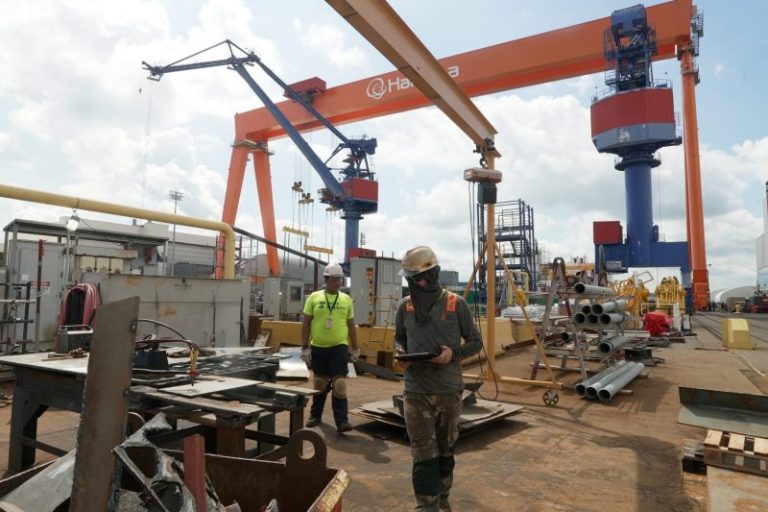
Hanwha Philly Shipyard CEO David Kim, nodding to the gargantuan vessels under construction just off the Delaware River, on Wednesday offered the kind of vision that has brought some optimism back to the U.S. shipbuilding community.

“You take that level of experience, the technology that we have, the know-how, the process expertise, and so clearly, we believe we have a lot to bring to the Philly Shipyard, as well as to the U.S. maritime industrial base, in terms of modernization capacity,” he said on a walkthrough of the shipyard.

Hanwha Philly Shipyard CEO David Kim.Obtained by NBC News

Hanwha Group bought the Philly Shipyard in December for $100 million and plans to invest multiple times that amount in the yard, training over a thousand new workers and bringing in new high-tech equipment. The company hopes to build naval ships and become the first U.S. builder of specialized liquefied natural gas tankers.

Shipbuilding in the United States has been all but dormant. China, South Korea, Japan and Europe all produce far more ships than the United States, with the few shipyards still operating in the country concentrating on military ships.

Revitalizing shipbuilding has been one of the areas President Donald Trump has pointed to as part of a broader effort to bring manufacturing back to the United States — a move some see as shortsighted considering the costs associated with building the kind of gigantic modern ships that remain a core part of how goods and commodities move around the planet.

This post appeared first on NBC NEWS

Join Tom as he covers key inflation data, earnings season highlights, and sector rotation trends. He breaks down recent price action in major indexes like the S&P 500 and Nasdaq, with a close look at the 20-day moving average as a support gauge. Tom spotlights standout industry groups such as gambling, semiconductors, software, and aerospace, and shares charts of top-performing stocks like Goldman Sachs, Johnson & Johnson, and PNC. Tom highlights under-performing areas like insurance brokers and home improvement, then reviews several strong earnings reactions, including Monarch Casino’s 15% after-hours gain.

This video was published on July 17, 2025. Click this link to watch on Tom’s dedicated page.

Missed a session? Archived videos from Tom are available at this link

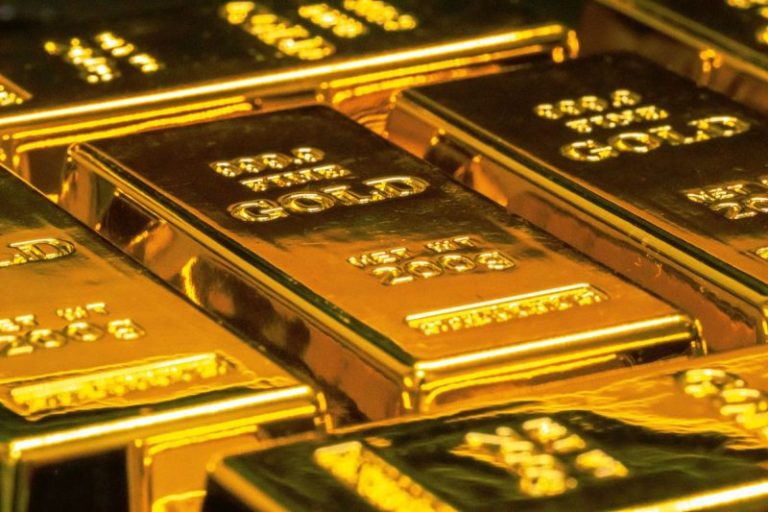
Gold has notched an extraordinary first half of 2025, climbing 26 percent in US dollar terms and setting 26 new all-time highs — but the rally now faces a murky and fragile second act shaped by inflation, monetary policy, and unresolved global tensions, according to the World Gold Council’s (WGC) recent mid-year report.

Investors around the globe turned to gold as both a tactical hedge and a strategic store of value, pushing trading volumes to an all-time high of US$329 billion per day in the first six months of the year.

The WGC’s mid-year outlook suggests the precious metal’s momentum could continue, but with significant caveats. Under current consensus forecasts, gold is likely to remain rangebound in the second half, potentially rising another 0 to 5 percent.

However, sharp deviations in macro conditions — particularly those involving stagflation, recession, or worsening geopolitical risks — could lift gold by an additional 10 percent to 15 percent before year-end.

A record-breaking first half

Gold’s 26 percent gain in H1 made it one of 2025’s top-performing major assets. The yellow metal benefited from a rare combination of global factors: a declining US dollar — which had its worst start to a year since 1973 — muted Treasury yields, and a sharp uptick in geopolitical tensions, many linked to US trade policies and regional flashpoints.

These factors created fertile ground for strong inflows into exchange-traded funds (ETFs), over-the-counter (OTC) markets, and futures.

Gold ETF holdings surged by 397 metric tons in the first half — the highest since August 2022 — bringing total holdings to 3,616 tonnes and pushing total assets under management to $383 billion, a 41 percent increase from the start of the year.

Central banks, too, continued to buy gold, albeit at a moderated pace compared to the record-setting quarters of 2022 and 2023. Although net purchases have slowed, they remain significantly above the pre-2022 average of 500–600 metric tons annually.

Why investors piled in

According to the WGC’s Gold Return Attribution Model (GRAM), three key drivers contributed to gold’s H1 surge: risk and uncertainty, opportunity cost, and momentum.

Investor demand stemming from heightened geopolitical and financial risks contributed approximately 4 percent of gold’s return, with half of that explained by a measurable increase in the Geopolitical Risk Index.

A further 7 percent of the return was attributed to changes in opportunity cost, primarily due to the weakening dollar and low bond yields, which made non-interest-bearing gold relatively more attractive.

Lastly, momentum effects, including continued ETF inflows and trend-following investment behavior, added another 5 percent, supporting the metal’s climb through positive feedback loops.

Altogether, these macro and market-based dynamics explained around 16 percentage points of gold’s 26 percent performance in the first six months of the year.

The outlook: Three scenarios for H2

While gold’s fundamentals remain supportive, analysts are cautious about expecting a repeat performance in H2. The WGC outlines three macroeconomic paths that could shape gold’s direction in the second half.

In the base case, moderate global growth and inflation settling near 5 percent could keep real yields subdued, especially if the US Federal Reserve cuts rates by 50 basis points in the fourth quarter.

This environment would likely support gold prices modestly, with forecasts pointing to gains of up to 5 percent. Continued interest from ETF and OTC investors could offset softer consumer demand and increased recycling, both of which may act as speed bumps for further upside.

The bull case envisions a sharp rise in gold if economic conditions worsen — either through stagflation or a full-blown recession.

A flight to safety could trigger renewed ETF inflows, central bank diversification away from the dollar, and heavier positioning in COMEX futures. Under this stress-driven rally, gold could surge another 10 to 15 percent in H2, echoing the strong performance seen during previous crises like 2008 and the early pandemic years.

On the flip side, a more stable geopolitical and macroeconomic environment, such as a resolution to major global conflicts or normalization in trade, would dampen demand for gold. In this bear case, stronger yields and renewed investor appetite for risk assets could pull gold down by as much as 12 to 17 percent.

No matter the outcome, gold continues to serve as a resilient portfolio hedge. Its strong showing in the first half of 2025 reaffirmed its utility in volatile markets, particularly as traditional safe havens like US Treasuries struggle to deliver.

Even if jewelry and retail demand sees pressure, structural support could come from institutional players — including reports that Chinese insurers are quietly upping their gold allocations.

For now, gold may consolidate. But should conditions turn, the metal still has plenty of room to move, in either direction.

Securities Disclosure: I, Giann Liguid, hold no direct investment interest in any company mentioned in this article.

This post appeared first on investingnews.com

Former Biden administration staffer Annie Tomasini is expected to appear before congressional investigators on Friday after being subpoenaed by House Oversight Committee Chairman James Comer, R-Ky.

Tomasini, former Assistant to the President and Deputy Chief of Staff for ex-President Joe Biden, was previously scheduled to appear for a voluntary transcribed interview on Friday.

A committee aide told Fox News Digital earlier this week that Tomasini’s counsel requested the subpoena, but did not say why. 

When she arrives for the 10 a.m. closed-door deposition on Friday, she will be the third ex-Biden administration aide to come under subpoena in Comer’s probe in recent weeks.

Comer is investigating allegations that Former President Joe Biden’s former top White House aides covered up signs of his mental and physical decline while in office, and whether any executive actions were commissioned via autopen without the president’s full knowledge. Biden allies have pushed back against those claims.

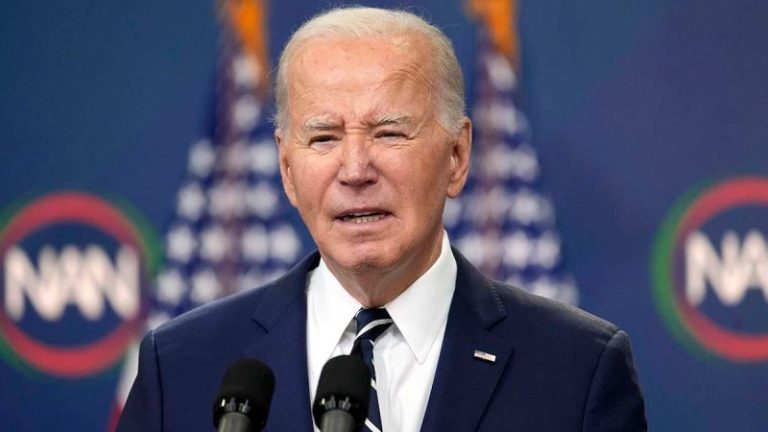
In an interview with The New York Times on Thursday, Biden affirmed he ‘made every decision’ on his own.

Just before Tomasini, House investigators heard from Anthony Bernal, a longtime aide to ex-first lady Jill Biden. 

Bernal pleaded the Fifth Amendment on all questions about Biden and was out of the committee room less than an hour after going in.

Lawmakers are largely not expected to attend the closed-door deposition, which is traditionally staff-led.

Comer has been to several so far, and progressive firebrand Rep. Jasmine Crockett, D-Texas, has made surprise appearances as well.

CNN anchor Jake Tapper and Axios political correspondent Alex Thompson revealed in their book, ‘Original Sin,’ that Tomasini and Bernal ‘loaded a written Q&A into a prompter ahead of a local interview – a document that the campaign had used in prep with Biden.’

Tomasini and Bernal brought out the teleprompter as his aides were trying to soften his blunders as Biden struggled to stay on message, according to the book. But the teleprompter fiasco became an easy attack line throughout Biden’s re-election campaign, as President Donald Trump ‘weaved’ through his myriad unscripted moments.

The book described how Tomasini and Bernal grew closer to Biden during the pandemic, eventually becoming Joe and Jill Biden’s most trusted aides. 

Tapper and Thompson describe the ‘intensely loyal’ duo – Tomasini and Bernal – as taking on an ‘older-brother-and-little-sister vibe’ among Biden’s inner circle.  

Bernal and Tomasini later took on some of the residence staffers’ roles in the White House. Tapper and Thompson said the aides ‘had all-time access to the living quarters, with their White House badges reading ‘Res’ – uncommon for such aides.’

‘The significance of Bernal and Tomasini is the degree to which their rise in the Biden White House signaled the success of people whose allegiance was to the Biden family – not to the presidency, not to the American people, not to the country, but to the Biden theology,’ the authors wrote. 

A source familiar with the Biden team’s thinking called House Republicans’ probe ‘dangerous’ and ‘an attempt to smear and embarrass.’

‘And their hope is for just one tiny inconsistency between witnesses to appear so that Trump’s DOJ prosecute his political opponents and continue his campaign of revenge,’ the source said.

This post appeared first on FOX NEWS

President Donald Trump said Wednesday that Coca-Cola in the United States will begin to be made with cane sugar, but the company did not explicitly say that was the case when it was asked later about Trump’s claim.

Trump said Wednesday afternoon on Truth Social that he had been speaking to Coca-Cola about using cane sugar in the sodas sold in the United States and that the company agreed to his idea.

‘This will be a very good move by them — You’ll see. It’s just better!’ Trump wrote in the post.

But Coca-Cola did not commit to the change when NBC News asked it later about Trump’s post.

‘We appreciate President Trump’s enthusiasm for our iconic Coca-Cola brand,’ a company spokesperson said in a statement. ‘More details on new innovative offerings within our Coca-Cola product range will be shared soon.’

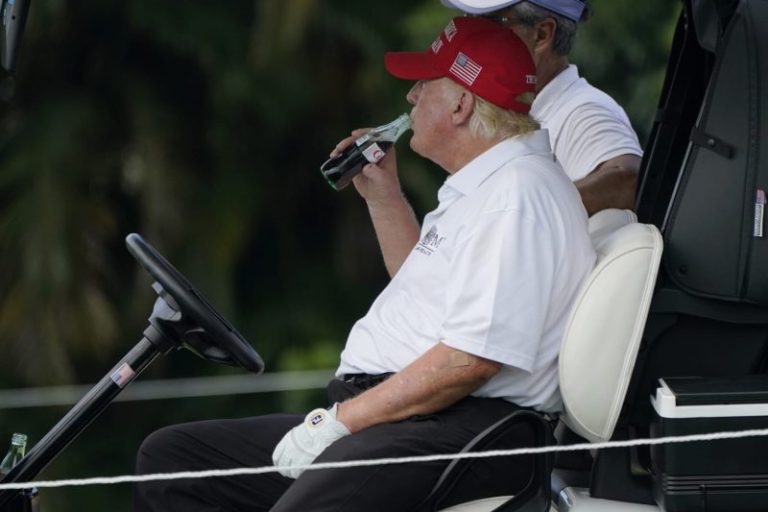
Donald Trump drinks a Diet Coke during the ProAm of the LIV Golf Team Championship at Trump National Doral Golf Club, on Oct. 27, 2022, in Doral, Fla.Lynne Sladky / AP file

It remains unclear whether Coca-Cola agreed to Trump’s proposal or whether the beloved soda will still be made with corn syrup.

The Trump administration’s Make America Healthy Again initiative, named for the social movement aligned with Health Secretary Robert F. Kennedy Jr., has pushed food companies to alter their formulations to remove ingredients like artificial dyes.

Coca-Cola produced for the U.S. market is typically sweetened with corn syrup, while the company uses cane sugar in some other countries, including Mexico and various European countries.

Coca-Cola announced in 1984 it was going to “significantly increase” the amount of corn syrup it was using in its U.S. products, The New York Times reported at the time.

Coca-Cola said it would use corn syrup to sweeten bottled and canned Coke, as well as caffeine-free Coke, but left itself “flexibility” to use other sweeteners, like sugar or high-fructose corn syrup, the Times reported.

Kennedy has criticized how much sugar is consumed in the American diet and has said updated dietary guidelines released this summer will advise people to ‘eat whole food.’

Trump has been known to enjoy Coca-Cola products. The Wall Street Journal reported that a Diet Coke button, which allows him to order the soda on demand, has joined him in the Oval Office for both of his terms.

This post appeared first on NBC NEWS

Join Grayson as he shares how to streamline your analysis using custom ChartStyles. He demonstrates how to create one-click ChartStyles tailored to your favorite indicators, use style buttons to quickly switch between clean, focused views, and build a chart-leveling system that reduces noise and helps you stay locked in on what matters most.

This video originally premiered on July 16, 2025. Click on the above image to watch on our dedicated Grayson Roze page on StockCharts TV.

You can view previously recorded videos from Grayson at this link.

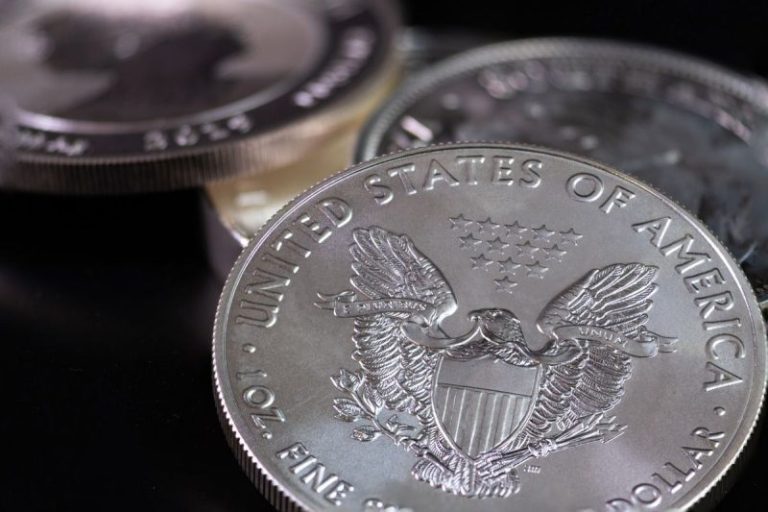
Silver took some luster from gold in Q2 as its price climbed to 14 year highs.

Many of the same contributors that affected the gold price were also in play for silver.

Uncertainty in financial markets, driven by a chaotic US trade and tariff policy, coincided with rising tensions in the Middle East and continued fighting between Russia and Ukraine, prompting investors to seek safe-haven assets.

Unlike gold, however, silver also saw gains as industrial demand strained overall supply.

What happened to the silver price in Q2?

The quarter opened with the price of silver sinking from US$33.77 per ounce on April 2 to US$29.57 on April 4. However, the metal quickly found momentum and climbed back above the US$30 mark on April 9.

Silver continued upward through much of April, peaking at US$33.63 on April 23.

Volatility was the story through the end of April and into May, with silver fluctuating between a low of US$32.05 on May 2 and a high of US$33.46 on May 23.

Silver price, April 1 to July 17, 2025.

Chart via Trading Economics.

At the start of June, the price of silver soared to 14 year highs, opening the month at US$32.99 and rising to US$36.76 by June 9. Ultimately, the metal reached a year-to-date high of US$37.12 on June 17. Although the price has eased slightly from its high, it has remained in the US$36 to US$37 range to the end of the quarter and into July.

Silver supply/demand balance still tight

Various factors impacted silver in the second quarter of the year, but industrial demand was a primary driver in both upward and downward movements. Over the past several years, silver has been increasingly utilized in industrial sectors, particularly in the production of photovoltaics. In fact, according to the Silver Institute’s latest World Silver Survey, released on April 16, demand for the metal reached a record 680.5 million ounces in 2024.

Artificial intelligence, vehicle electrification and grid infrastructure all contributed to demand growth

At the same time, mine supply has failed to keep up, with the institute reporting a 148.9 million ounce production shortfall. This marked the fourth consecutive year of structural deficit in the silver market.

“(We have) flat supply, growing demand — demand that’s nearly 20 percent above supply,’ he said. ‘And our ability to meet those deficits is shrinking because we’re tapping into these aboveground stockpiles that have shrunk by about 800 million ounces in the last four years, which is equivalent to an entire year’s mine supply. So it’s the perfect storm.’

But industrial demand can send the silver price in either direction.

The chaos caused by Trump’s on-again, off-again tariffs has caused some consternation among investors.

While gold and silver have traditionally both been viewed as safe-haven assets, silver’s increasing industrial demand has decoupled it slightly from that aspect. When Trump announced his ‘Liberation Day’ tariffs on April 2, silver was impacted due to fears that a recession could cause demand for the metal to slip.

Although the dip in silver was short-lived, it was one of its steepest falls in recent years.

“If a global recession really starts, silver will most likely nosedive momentarily. In terms of its 2025 performance, silver growth has been largely bolstered by consolidated precious metals group appreciation, additionally beefed up by relative USD weakness.’

Geopolitics and the silver price

Adding to the tailwinds is a growing east-west divide. Due to its usage in industrial components, particularly those related to the military and energy sectors, and its role as a safe haven, silver is being influenced by geopolitics.

June’s price rally came alongside growing speculation that Israel was preparing to attack Iranian nuclear sites. Investors became concerned that war could disrupt international trade and oil movements in the region.

Ultimately, their concerns were proven right, and Israel launched attacks on June 12; the US then bombed key nuclear facilities on June 21. While the escalation is new, the underlying politics have been simmering for years.

Sanctions against Russia have strengthened support among the BRICS nations, which have been working to reduce their reliance on US dollar assets, such as treasuries, and increase trade in their own currencies.

But they may also be working to separate themselves from western commodities markets. In October 2024, Russia floated the idea of creating a precious metals exchange to its BRICS counterparts. If established, it could shake up pricing for commodities like silver, allowing Russia to circumvent sanctions and trade with its bloc partners.

While the exchange is still just an idea, a bifurcated world is not. While the US has targeted most nations with tariffs, it has singled out China. Much of the first half of the year saw the world’s two largest economies escalate import fees with one another, with China even restricting the export of rare earth elements to the US.

Discussions on national security and critical minerals have been at the forefront for the last several years. Still, they have become even more pronounced with the US and China on tense footing.

“Even if that’s going to happen, industrial use value — building infrastructure, building national security, national energy priorities — needs a lot of silver, and there just simply isn’t enough supply out of the ground to meet the demand. That’s long-term demand above the ground. This has been a thing, but right now, because of these geopolitical forces and realignments, silver is going to drop more into that industrial role,” she said.

Silver price forecast for 2025

Overall, the expectation is that without new mine supply and dwindling aboveground stockpiles, silver is likely to remain in deficit for some time. Other factors, like Trump tariffs and geopolitics, aren’t likely to disappear either.

Demand could ease off if a global recession were to materialize, but safe-haven investing could offset declines.

For his part, Krauth thinks the silver price is likely to remain above the US$35 mark, but it could fluctuate and he suggested a rally in the US dollar could push the silver price down. However, he also sees some pressure easing on the recession side of the equation if the US signs tariff deals that would eliminate some uncertainty.

“US$40, let’s say by the end of this year,’ he said, adding, ‘Frankly, I could see something really realistically above that, maybe an additional 10 percent if the scenario plays out right.’

He doesn’t think that’s the end. In the longer term, Krauth sees silver going even higher. He pointed to the current gold-silver ratio, which is around 92:1, compared to an average of 60:1 over the last 50 years.

“So we could go to, who knows, somewhere like maybe 40 or 30 to one in the ratio. That would be tremendous for silver — that could bring silver above US$100. I’m not saying that’s happening tomorrow, but in the next couple of years I would say that’s certainly something that could easily be in the cards,” Krauth said.

Fundamentals and geopolitics aligned for silver in the first half of 2025, and barring a recession, they are likely to provide tailwinds in the second half. Whether the price climbs or continues to find support at US$35 is yet to be seen.

Securities Disclosure: I, Dean Belder, hold no direct investment interest in any company mentioned in this article.

This post appeared first on investingnews.com
This week, Republican members of the Senate Judiciary Committee will once again be asked to draw the line between what is permissible and impermissible for a Trump nominee, when they decide whether Emil Bove’s nomination to the Third Circuit Court of Appeals should receive a full Senate vote.

Confirming Bove would mean redrawing that line to ignore serious concerns about his truthfulness under oath. I was in the room when he made statements that my colleagues and I understood as threats—meant to pressure us into signing a motion to dismiss the federal criminal case against New York City Mayor Eric Adams. Mr. Bove has since denied making any such statements in testimony before the Senate Judiciary Committee, but those denials do not reflect what actually took place.

In February of this year, then-Acting Deputy Attorney General Emil Bove ordered prosecutors in my former office, the Public Integrity Section, to dismiss the bribery case against Mayor Adams. Bove openly admitted in a memorandum that the dismissal was unrelated to the facts and the law. This led to the resignation of five Public Integrity Section prosecutors, including me, to go along with prosecutors from the U.S. Attorney’s Office in New York, who also refused the order and resigned. 

The Public Integrity Section has since been reduced to less than five prosecutors, meaning the only component of the Justice Department’s Criminal Division dedicated to prosecuting domestic public corruption exists almost entirely in name only today. 

In his written responses to members of the Senate Judiciary Committee, Bove flatly denied that he ever so much as suggested a threat to me and my colleagues, explaining that during the meeting with our section, ‘[i]t was never my intention to coerce, pressure, or induce an DOJ attorney – through adverse employment actions, threats, rewards, or otherwise – to sign the motion to dismiss the charges against Mayor Adams.’ But by the time of that meeting, it’s undisputed that he had already accepted the forced resignation of the U.S. Attorney in New York, put line prosecutors from that office on administrative leave for not signing the motion, and forced the entirety of the Public Integrity Section’s management to resign when it refused to carry out his order. And how does his denial square with his admission that he generally recalls ‘[telling us] he didn’t want to get anyone in trouble … so he didn’t want to know who was opposed to signing the motion’? 

Bove’s nomination would mark a troubling precedent: confirming a nominee who, in my view, gave testimony that was so obviously misleading to the committee and the American public. That’s what makes this so profoundly disturbing. Previous contested judicial confirmation hearings have involved accusations where one nomination’s credibility was pitted against that of an accuser, or judicial credentials were questioned. But never before has a nominee testified in such a demonstrably brazen manner with a wink and nod to the Republican committee members. 

There is only one realistic hope to prevent Bove’s nomination from moving forwardto a full floor vote, and it rests on the shoulders of Sen. Thom Tillis. The North Carolina Republican, a staunch conservative, has previously demonstrated political courage by speaking for his principles, not his party, on many issues. He believes in ‘calling the balls and strikes.’ 

Sen. Tillis prevented the confirmation of Edward Martin, the woefully unqualified nominee for U.S. Attorney in the District of Columbia, who used his office to pen threatening, typo-ridden letters to Democratic members of Congress, defense attorneys, and Georgetown University. Bove poses a far graver threat, in that his would be a lifetime tenure to a judicial branch he believes should not be a check on the president’s power.

Moreover, Trump’s latest tussle with Leonard Leo and the Federalist Society further reveals that he is no longer looking for jurists who are conservatives, but rather, loyalists. So, who would be better to elevate from a federal circuit court to the Supreme Court if Justices Thomas or Alito decided to retire before 2028 than Bove? 

On the Sunday night before I sent my resignation letter to Attorney General Bondi (Bove was cc-ed) on Monday, I was clearing out my belongings from my office when I noticed that someone had prominently placed a plaque on our reception desk. It quoted Abraham Lincoln: ‘If you want to test a man’s character, give him power.’ 

Bove served as line prosecutor earlier in his career – he knows the prosecutor’s code. But, in my experience, it appears that once he had a whiff of power, Bove was willing to abuse it. With his smug testimony, Bove has essentially called the Republicans’ bluff, believing that Sen. Tillis and the others won’t have the courage to vote against him.

Citizens of all political persuasions should hope that Sen. Tillis shows the courage and character that Bove lacks by voting no on his confirmation.

This post appeared first on FOX NEWS

Consumer prices rose in June as President Donald Trump’s tariffs began to slowly work their way through the U.S. economy.

The consumer price index, a broad-based measure of goods and services costs, increased 0.3% on the month, putting the 12-month inflation rate at 2.7%, the Bureau of Labor Statistics reported Tuesday. The numbers were right in line with the Dow Jones consensus, though the annual rate is the highest since February.

Excluding volatile food and energy prices, core inflation picked up 0.2% on the month, with the annual rate moving to 2.9%, with the annual rate in line with estimates. The monthly level was slightly below the outlook for a 0.3% gain.

A worker prices produce at a grocery store in San Francisco, California, US, on Friday, June 7, 2024.David Paul Morris / Bloomberg via Getty Images

Prior to June, inflation had been on a generally downward slope for the year, with headline CPI at a 3% annual rate back in January and progressing gradually slower in the subsequent months despite fears that Trump’s trade war would drive prices higher.

While the evidence in June was mixed on how much influence tariffs had over prices, there were signs that the duties are having an impact.

Vehicle prices fell on the month, with prices on new vehicles down 0.3% and used car and trucks tumbling 0.7%. However, tariff-sensitive apparel prices increased 0.4%. Household furnishings, which also are influenced by tariffs, increased 1% for the month.

Shelter prices increased just 0.2% for the month, but the BLS said the category was still the largest contributor to the overall CPI gain. The index rose 3.8% from a year ago. Within the category, a measurement of what homeowners feel they could receive if they rented their properties increased 0.3%. However, lodging away from home slipped 2.9%.

Elsewhere, food prices increased 0.3% for the month, putting the annual gain at 3%, while energy prices reversed a loss in May and rose 0.9%, though they are still down marginally from a year ago. Medical care services were up 0.6% while transportation services edged higher by 0.2%.

With the rise in prices, inflation-adjusted hourly earnings fell 0.1% in June, the BLS said in a separate release. Real earnings increased 1% on an annual basis.

Markets largely took the inflation report in stride. Stock market indexes were mixed while Treasury yields were mostly negative.

Amid the previously muted inflation ratings, Trump has been urging the Federal Reserve to lower interest rates, which it has not done since December. The president has insisted that tariffs are not aggravating inflation, and has contended that the Fed’s refusal to ease is raising the costs the U.S. has to pay on its burgeoning debt and deficit problem.

Central bankers, led by Chair Jerome Powell, have refused to budge. They insist that the U.S. economy is in a strong enough position now that the Fed can afford to wait to see the impact tariffs will have on inflation. Trump in turn has called on Powell to resign and is certain to name someone else to the job when the chair’s term expires in May 2026.

Markets expect the Fed to stay on hold when it meets at the end of July and then cut by a quarter percentage point in September.

This post appeared first on NBC NEWS

Relatively healthy earnings reports from the big banks and a June inflation report that came in line with analyst expectations didn’t give the stock market much of a lift, as the S&P 500 ($SPX) and Dow Jones Industrial Average ($INDU) both ended the day lower. The only major index to shine was the Nasdaq Composite ($COMPQ), which closed at a record high.

Technology stocks were the stars of the show. It wasn’t a blowout rally, but the sector still managed to finish in the green. Why? There were a couple of key developments that gave tech a nice boost.

First, semiconductors got some breathing room. Restrictions on chip sales to China were relaxed, and that gave big names like NVIDIA Corp. (NVDA) and Advanced Micro Devices (AMD) a reason to rally. 

Second, there’s a push from the government to invest in AI and energy initiatives in Pennsylvania. One of the biggest winners was Super Micro Computer, Inc. (SMCI), which jumped 6.9% — the biggest percentage gain in the S&P 500. You can see from the StockCharts MarketCarpet for the S&P 500 stocks that, besides the top-weighted stocks in the index, it was mostly a sea of red.

FIGURE 1. MARKETCARPET FOR TUESDAY, JULY 15. Technology was the clear leader, with the largest cap-weighted stocks leading the sector higher.Image source: StockCharts.com. For educational purposes.

Semiconductors Show Strength

If you’ve been watching semiconductors, you may have noticed that the SPDR S&P Semiconductor ETF (XSD) has been on a roll. Since April, the ETF has stayed above its 20-day exponential moving average (EMA). The relative performance of XSD against the SPDR S&P 500 ETF (SPY) has been improving, and its relative strength index (RSI) is at around 62, an indication that momentum is at healthy levels (see chart below). It’s important to note that since May, the RSI has remained above 50, which is supportive of XSD’s upside movement.

Note: StockCharts members can access this chart from the Market Summary page or the Market Summary ChartPack (under US Industries > Bellwether Industries).

FIGURE 2. DAILY CHART OF XSD. Since April, XSD has been trending higher and is now trading above its 21-day EMA.Chart source: StockCharts.com. For educational purposes.

How to Track Semiconductor Stocks

If the environment for semiconductors remains strong, there could be more upside for stocks in that space. A simple way to keep tabs on the stocks using StockCharts tools is to create a ChartList of semiconductor stocks you’re interested in owning.

  • Begin by heading to the US Sectors panel in the Market Summary page or the Sector Summary page on your Dashboard.
  • Click Sector Drill-Down > Technology Sector Fund > Semiconductors.
  • You’ll see the list of semiconductor stocks that make up the industry group.

From there, I prefer to sort the data by the Universe (U) column, starting with the large caps and then the StockCharts Technical Rank (SCTR) score to find large-cap technically strong stocks. You can then view the charts on the list. If you see a chart that appears to have a favorable risk-to-reward ratio, you can save it to your Semiconductor ChartList.

FIGURE 3. SEMICONDUCTOR STOCKS TO REVIEW. The sector drill-down will uncover stocks in leading sectors or industry groups. Scroll down the list to identify charts that meet your investment or trading criteria. Image source: StockCharts.com. For educational purposes.

As you review the charts in your ChartList, you can identify potential support and resistance levels and set alerts to notify you when prices reach your key levels. It’s a great way to stay proactive.

The Bottom Line

This type of top-down analysis helps you stay one step ahead of the market. Start with the broad market, then narrow down to sectors, then industry groups, and then individual stocks. By taking a proactive approach to managing your investments, you’re always preparing for the stock market’s next move.


Disclaimer: This blog is for educational purposes only and should not be construed as financial advice. The ideas and strategies should never be used without first assessing your own personal and financial situation, or without consulting a financial professional.